





A gray outdoor HVAC condenser unit mounted on a concrete pad in the front yard of a two-story suburban house.

Heat Pump Repair in Sheridan, AR

Tell us about the job

Takes about a minute. No obligation.

RepairHeat PumpGrant County, AR
Step 1 of 2

What ZIP code is the job in?

A heat pump here runs May through September for cooling, then switches over and runs November through March for heat. October sits right before that switch. A capacitor or contactor that was already weak by September doesn't get a rest, it just gets asked to push heat instead of cold air. Most failures show up in the first real cold snap, once the system is actually working hard in the new direction. Having it looked at in October catches a weak part before it quits on you in November.

5 months
November through March, your system heats
5 months
May through September, it cools
34°F
the average winter night it heats against
91°F
the average summer afternoon it cools against
Isometric cutaway illustration of a single-story house showing interior rooms, attic ductwork and an air handler, with an outdoor condenser unit connected by lines along the exterior wall.
Your system heats November through March and cools May through September.

NOAA nClimDiv, 1991–2020 normals

Grant County logged 67 severe weather events between 2015 and 2024, most of them wind and hail.

A heat pump repair call here is usually a worn part on its normal schedule, not storm damage.

Half the homes in Grant County were built in 1991 or later

Half the homes here were built by 1991
Power costs 12.32 cents a kWh statewide
Climate zone 3A

If your heat pump is original to the house, 1991 or later still puts a lot of systems within reach of a fair repair rather than a replacement. A worn contactor or a failing capacitor doesn't care how old the house is, but a system that's had a reasonable life left in it is worth fixing rather than writing off. Worth asking the contractor straight out whether the part on hand is worth repairing given the system's age, before anyone talks about swapping the whole unit.

Get it looked at early

Problems tend to show up in the first weeks of the season, when the load hits a part that was already weak.

Find a contractor
A residential heat pump outdoor unit mounted on a concrete pad next to a house with gray vinyl siding.

What a failing heat pump sounds and feels like

A heat pump that's struggling doesn't usually just quit. It gives you notice first. Short cycling is one of the clearest signs, the system kicking on, running a few minutes, and shutting off again before it's done anything useful. Ice building up on the outdoor unit during a heating run is another, especially if the defrost cycle isn't clearing it anymore. Listen for it too. A hum with no fan movement points to a failing capacitor. A loud click followed by nothing points to a contactor that's no longer making good contact. Air coming out lukewarm instead of hot or cold often means the reversing valve isn't switching all the way. None of these fix themselves, and all of them put more strain on the parts around them the longer they run.

Check the thermostat before anything else

Make sure it's set to heat or cool as needed and the temperature is actually set past room temperature. Check the batteries if it uses them. A thermostat that's lost power or slipped into the wrong mode looks exactly like a dead system.
Look at the outdoor unit and the filter

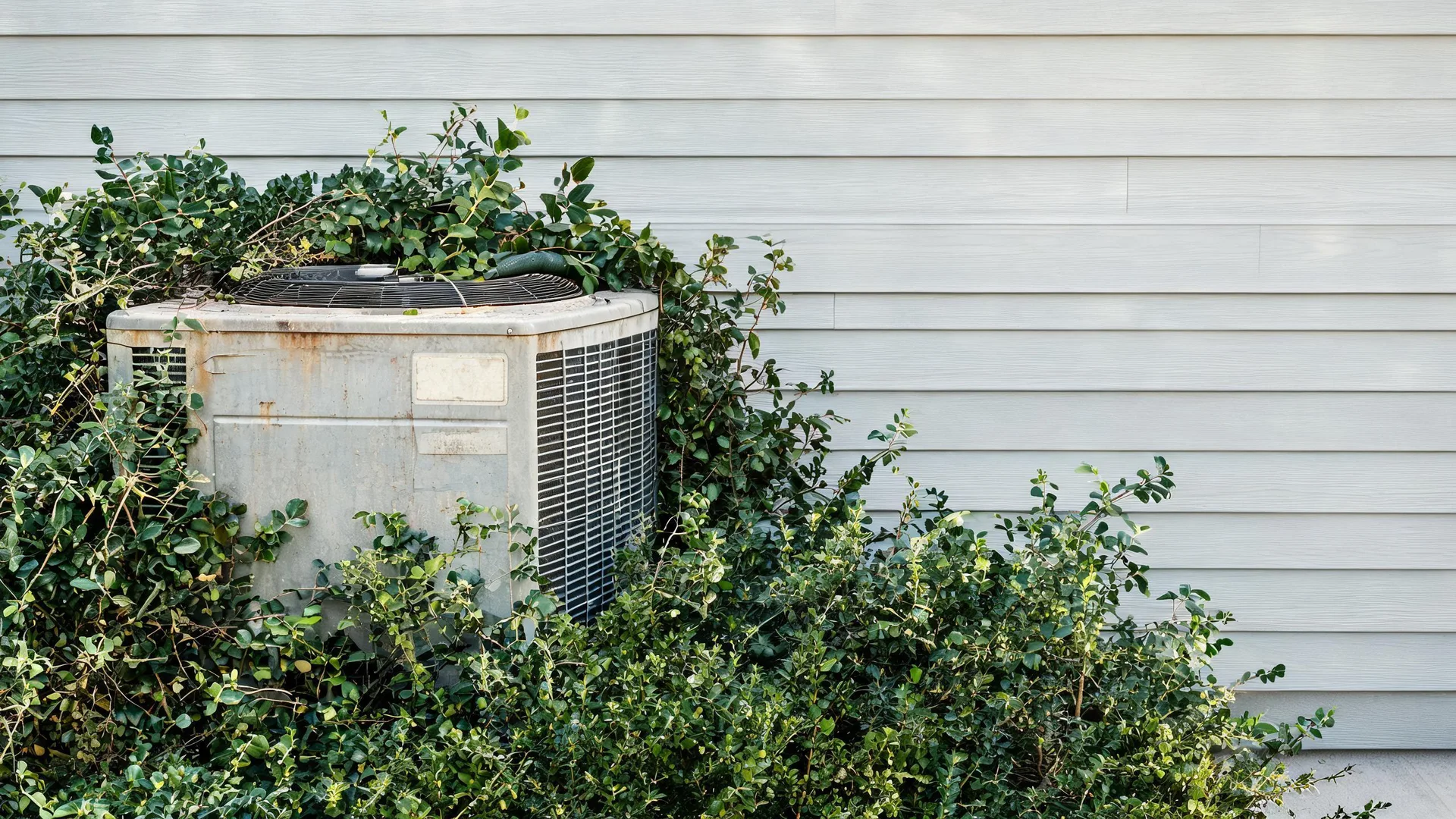
Walk outside and check that nothing is blocking the outdoor unit, no leaves, no fence or furniture pushed up against it. Then check the air filter inside. A filter clogged enough to choke airflow can make a heat pump run weak or trip it off entirely, and it's the one part meant to be pulled and checked without a tech.

A struggling part rarely fails quietly and stays that way, it keeps drawing on the parts around it until one of them gives too. A weak capacitor makes the compressor pull harder to start, and a compressor that works that hard runs hotter than it should. A contactor with pitted contacts arcs a little more each time it closes, and that arcing wears it down faster than normal use would. Ice left on the outdoor coil because the defrost cycle isn't clearing it blocks airflow, and the system responds by running longer to make up for it, which only holds the ice there. None of this resets when the unit finally shuts off for the night. It picks back up exactly where it left off the next time it kicks on, a little worse than before.

A repair is usually the right call when it's one part doing the failing. A capacitor, a contactor, a blower motor. Swap the weak part and the rest of the system goes back to doing what it was already doing fine, the coils, the compressor, the lines. Replacement starts to make more sense when the compressor itself is the problem. That's the part that moves heat in both directions, and it's the most expensive thing in the unit to replace on its own. It also makes sense when the same system keeps coming back with a new failure every season. That pattern usually means the whole unit is wearing out at once, not just the part in front of you this time. A contractor looking at a failed part can usually tell which kind of problem you've got just by seeing what else around it shows wear.