



An outdoor air conditioning condenser unit mounted on a concrete pad next to a residential house at sunset.

Heat Pump Repair in Malvern, AR

Tell us about the job

Takes about a minute. No obligation.

RepairHeat PumpHot Spring County, AR
Step 1 of 2

What ZIP code is the job in?

May is when a heat pump in Malvern earns its keep, and it's also when a weak part finally gives out. A capacitor that limped through a mild April can't keep up once the heat sets in and the system is running for hours at a stretch. Same story in November, on the other end, when the unit switches over to heat and a problem that sat quiet all summer shows up on the first cold morning. If your heat pump is struggling right as the season turns, that timing is a clue, not a coincidence. Getting it looked at before the full season hits means the fix happens on your schedule instead of during the week you need the system most.

5 months
November through March, your system heats
5 months
May through September, it cools
33°F
the average winter night it heats against
91°F
the average summer afternoon it cools against
Isometric cutaway illustration of a single-story house showing interior rooms with ductwork, an indoor air handler unit, and an outdoor condenser unit connected by lines along the exterior wall.
Your system heats November through March and cools May through September.

NOAA nClimDiv, 1991–2020 normals

The reversing valve is what lets a heat pump switch between heat and cooling, and it's one of the more common failure points.

When a heat pump gets stuck in one mode or won't switch over, that valve is usually the first thing a tech checks.

Half the homes in Hot Spring County were built in 1979 or earlier, and half in 1979 or later, so the age of your house doesn't point to one likely cause here. An older heat pump and a newer one fail in different ways, but the county's mix doesn't lean toward either. The one thing worth checking is whether yours sits in a mobile home, since close to a quarter of homes in the county do. A mobile home often runs a different heat pump setup than a house, and that changes what a tech checks first. Outside of that, nothing about a home here makes a heat pump more likely to break down. The cause is almost always one part, found by someone who checks the system instead of guessing at it.

Get it looked at early

Problems tend to show up in the first weeks of the season, when the load hits a part that was already weak.

Find a contractor
A man in a cap, dark jacket and tan work pants, seen from behind, carries a canvas tool bag up porch steps toward a green front door beside a potted shrub.
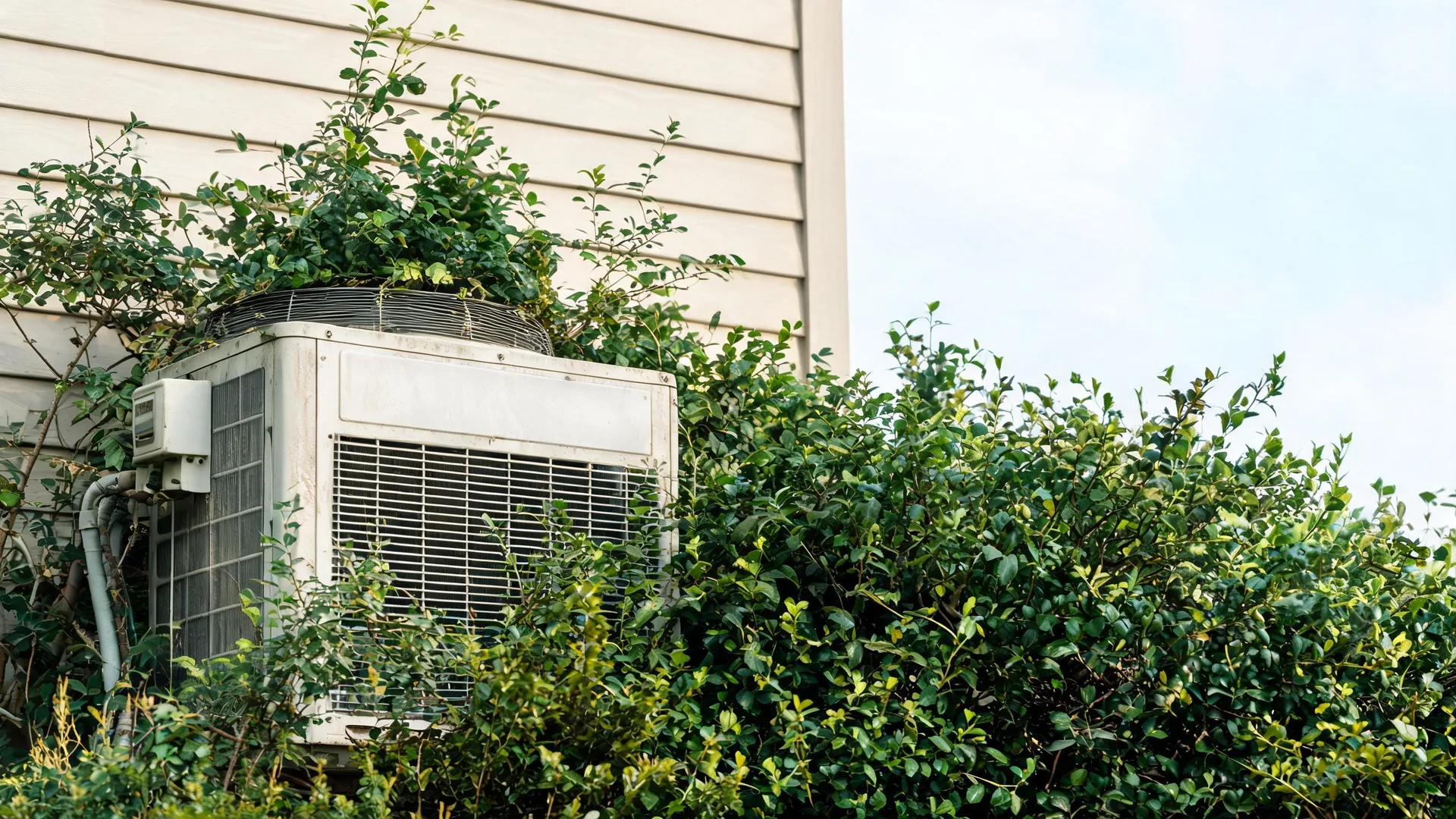
A white mini-split heat pump outdoor unit mounted on a concrete pad beside a gray-sided house, surrounded by gravel and green shrubs.

What to check yourself first

Before anyone comes out, check the thermostat first. Make sure it's set to heat or cool as you expect, with the temperature actually set past room temperature. Next, go to the air handler or indoor unit and look at the filter. A filter clogged with dust chokes off airflow, and a heat pump starved for air will ice up or struggle to keep temperature no matter what else is wrong with it. Walk outside and look at the outdoor unit. Clear away leaves, grass clippings or anything stacked against it, since it needs open air on all sides to move heat in or out. If you see a heavy coat of ice on the outdoor coil and it's not actively in a defrost cycle, that's worth noting for the tech, not something to chip off yourself. Check the circuit breaker for the unit too. A tripped breaker is sometimes a loose connection and sometimes a sign the compressor is pulling too much current, but flipping it back on once is reasonable before you call. Beyond that, leave the refrigerant lines, the electrical panel and the reversing valve alone. Those need gauges, meters and training to touch safely.

What you'll actually notice first

A heat pump in trouble rarely just stops. It blows air that isn't warm or cool enough. It runs longer than it used to without catching up, or it cycles on and off in short bursts. Some homeowners hear it before they feel it. A clicking at startup. A hum with no fan movement. A rattle that wasn't there last season. Ice on the outdoor unit outside of a normal defrost, or cold air coming out during heat mode, is worth paying attention to rather than waiting out.
Why a small problem doesn't stay small

A heat pump rarely fails all at once. A weak capacitor makes the compressor strain every time it starts, and that strain wears the compressor down. A dirty coil makes the whole system run longer to reach the same temperature, and that extra runtime stresses the parts downstream of it. Left alone, the part causing the trouble tends to take others down with it. A system that's working harder than it used to is telling you something before it quits altogether.

A compressor is the part a tech least wants to see fail, and it's almost never the part that fails first. It fails because something smaller made it work too hard for too long. A weak capacitor forces it to strain on every startup. Low refrigerant from a slow leak makes it run hotter than it's built to run. A dirty coil makes it push longer to hit the same temperature. The compressor just absorbs that extra strain, cycle after cycle, until it stops starting at all. That's why a tech wants to catch the capacitor or the leak early, while it's still just that part acting up. Replace the small part in time and the compressor behind it keeps running the way it was built to.

A diagnostic visit starts with questions, not tools. A tech wants to know what the system is doing, when it started, and whether it happens in heat mode, cool mode, or both. Then comes the gauges and meters, checking the capacitor's output, the compressor's amp draw, the charge in the lines. Each reading rules something out or points somewhere specific. A tech will also run the system through a full cycle, watching how it starts, how it switches between heat and cool, and whether the reversing valve moves when it's told to. Most of the time the cause shows up in that process rather than from guesswork. The visit ends with a plain answer. What's failing, why it's failing, and what happens if it's left alone.