Two illuminated white Southern-style houses with wraparound porches and staircases, framed by a Spanish moss-draped tree on a quiet street at night.

Heat Pump Repair in Hot Springs, AR

Tell us about the job

Takes about a minute. No obligation.

RepairHeat PumpGarland County, AR
Step 1 of 2

What ZIP code is the job in?

Garland County sees real storm damage

Garland County logged 131 severe weather events between 2015 and 2024, including damaging wind, hail and tornadoes. An outdoor heat pump sits through all of it, with nothing but a thin cabinet between its coil and whatever a storm throws at it.


A unit can take a hit and keep running

A heat pump that still turns on after a storm can have a bent fin, a cracked fan blade or a dented cabinet that only shows up as a problem later. If your outdoor unit has been through hail or high wind, it is worth having someone look at it even though it still starts.

6 months
November through April, your system heats
5 months
May through September, it cools
33°F
the average winter night it heats against
90°F
the average summer afternoon it cools against
Isometric line illustration of a cutaway single-story house showing interior rooms with beds and furniture, ceiling ductwork connected to an indoor air handler, and an outdoor condenser unit linked by refrigerant lines.
Your system heats November through April and cools May through September.

NOAA nClimDiv, 1991–2020 normals

Heat here starts in November, right after an October that asks nothing of the heat pump.

A weak part can sit through October and fail the first cold week of November.

Half the homes in Garland County were built in 1984 or later, so there's a real chance yours is one of them. If your heat pump came with a newer house, it's probably not old enough for age alone to be the problem. A compressor or control board failing well short of its expected life is usually a sign of something specific, a bad capacitor, a refrigerant leak, a board damaged by a power surge, not old age catching up with the unit. That points toward a repair rather than a replacement. Worth checking what year your system went in, especially if it came with the house.

If this storm season has already hit your unit, get it looked at now

Garland County gets hail, high wind and the odd tornado most years, and the outdoor unit has nothing covering it but a thin cabinet. If yours has been through a storm recently and still runs, that's not proof it came through clean. Have it checked before a bent fin or cracked blade turns into a breakdown.

Find a contractor
A man in a cap, dark long-sleeved shirt and worn brown work pants walks up porch steps toward a green front door, carrying a canvas tool bag in his right hand, with a potted plant beside the door.
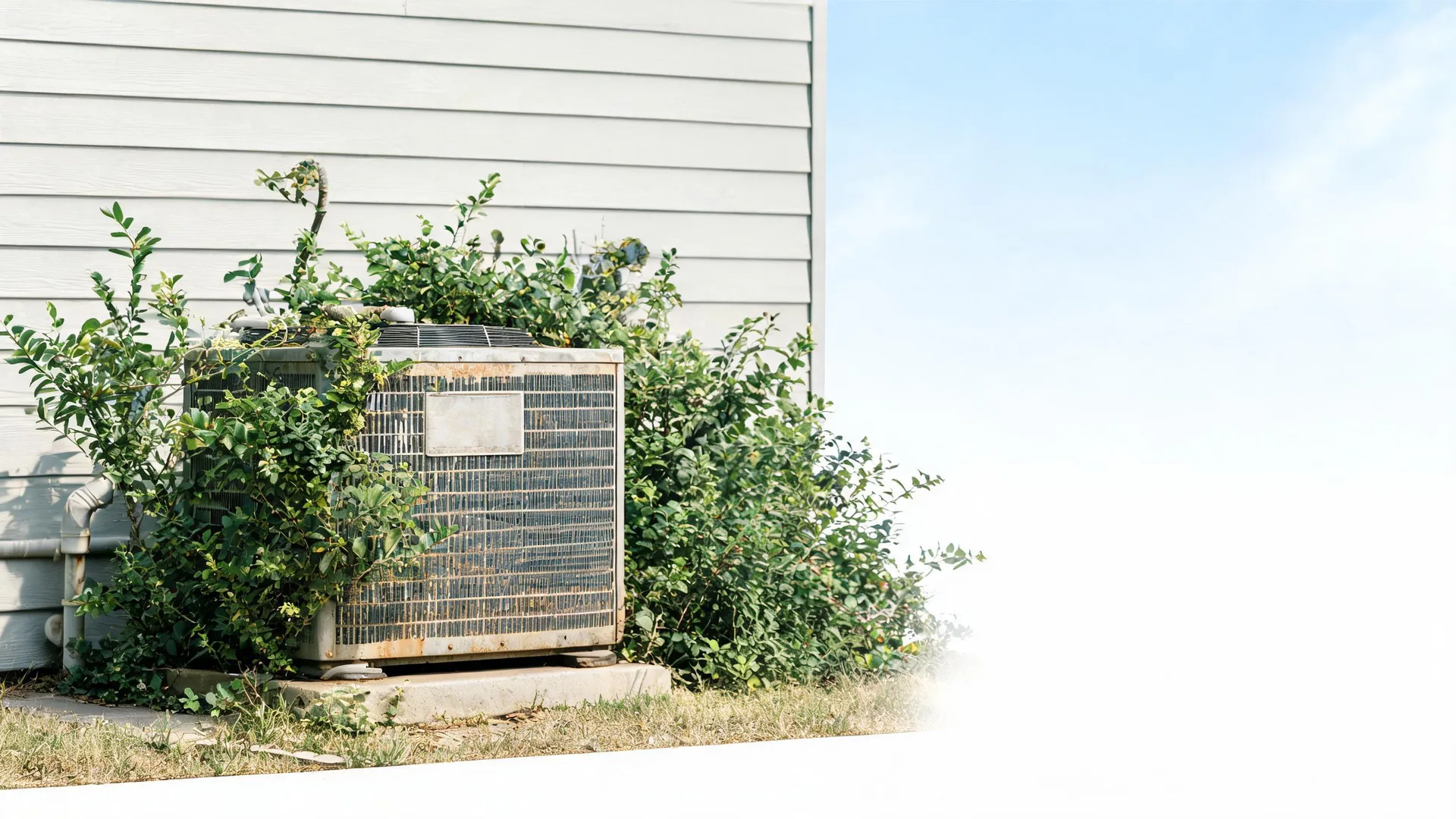
A gray heat pump outdoor unit mounted on a concrete pad next to a residential house with lap siding and stone accents.

Years of hail add up on a unit that never comes inside

Garland County logged 57 hail events between 2015 and 2024. Every one of those passed over the outdoor unit sitting outside, whatever the season. Hail dents a cabinet and bends coil fins even when the heat pump keeps running afterward, and a bent fin cuts airflow across the coil a little more each time it happens. That kind of damage does not show up as a breakdown right away. It shows up as the system working harder than it should to do the same job, and running harder for longer wears the parts behind it sooner.

The heat pump runs but the air feels wrong

A heat pump that still comes on can blow air that is barely warm, or it can run long stretches without the house ever feeling done. Weak heat at the vents often points to low refrigerant or a reversing valve that is not shifting all the way. A system that runs and runs without satisfying the thermostat is doing work without delivering heat, and that is worth a look before it quits outright.

Sounds and cycles tell you where to look

A hard bang or screech at startup usually comes from the compressor or the fan motor, not from ductwork. Short cycling, where the unit shuts off and restarts every few minutes, points to a failing capacitor, a dirty sensor, or airflow blocked somewhere between the coil and the vents. Ice building up on the outdoor coil that does not clear during the defrost cycle means the defrost control or a sensor is not doing its job.

A heat pump works year round, so its parts wear on both sides of the system, not just one. The reversing valve is the part unique to a heat pump, and when it sticks, the system can blow cold air in heating mode or get stuck between cycles. Refrigerant leaks show up at joints and fittings over time, and a system low on charge makes the compressor work harder to move heat that isn't there. Capacitors weaken with age and heat exposure, and a weak capacitor makes the compressor or fan motor struggle to start, which is often what short cycling points back to. Contactors pit and stick from the constant making and breaking of current, leaving a unit that won't start or won't shut off. None of these failures care about the season. They just show up when the part finally gives out.

A heat pump failing is not the same question as a heat pump worth replacing. Most single-part failures, a bad capacitor, a stuck contactor, a sensor that drifts out of calibration, are worth fixing regardless of the unit's age, because the rest of the system has no reason to fail just because one part did. What changes the math is the compressor. It is the most expensive part in the system and the hardest to replace on its own, so a compressor going bad on an older unit is usually where someone chooses to replace the whole thing rather than patch it. A system that has needed several different repairs in a short stretch is also telling you something, even if each one was minor on its own. One failure is a part wearing out. A pattern of them is the system reaching the point where parts start going together.