






Night view of illuminated white Southern-style houses with wraparound porches beneath Spanish moss-draped oak trees.

Heat Pump Repair in Benton, AR

Tell us about the job

Takes about a minute. No obligation.

RepairHeat PumpSaline County, AR
Step 1 of 2

What ZIP code is the job in?

Before you call anyone, take a look at the outdoor unit. Check that nothing is pressed up against it, no leaves, no fallen branches, no storage bins someone stacked nearby. Airflow in and out of that unit matters, and a blocked cabinet can cause a lot of the same symptoms as a real failure. Next, go to the thermostat and make sure it's set to the mode you think it's in and that the setpoint actually calls for heat or cooling. Then check your breaker panel for a tripped switch. If the outdoor unit is clear, the thermostat looks right, and the breaker is fine, but the system still isn't doing its job, that's worth a call.

5 months
November through March, your system heats
5 months
May through September, it cools
33°F
the average winter night it heats against
90°F
the average summer afternoon it cools against
Isometric cutaway illustration of a single-story house showing interior ductwork, an indoor air handler, and an outdoor condenser unit connected by lines along the exterior wall.
Your system heats November through March and cools May through September.

NOAA nClimDiv, 1991–2020 normals

Saline County logged 67 hail events between 2015 and 2024.

A heat pump that takes hits like that needs a real diagnosis, not a guess.

Half the homes in Saline County were built in 1997 or later, new enough that a heat pump likely has years left in it

Half the homes here were built by 1997
67 hail events from 2015 to 2024
Power costs 12.32 cents a kWh statewide
Benton heat pump repairHeat runs here November through March, and October is when a weak system starts to show it.

Saline County saw 70 damaging wind events between 2015 and 2024, on top of hail and a handful of tornadoes. Wind drives debris into the outdoor unit's coil and fan, and hail dents the fins even when the cabinet looks fine from a few feet away. A heat pump can keep running for weeks after a storm bent the fins or knocked the fan blade out of true, just running worse, pulling more power, wearing the compressor down faster. If a storm has come through since it last worked right, that history matters as much as what it's doing today. Tell the contractor about the storm when you call, not just the symptom.

A newer system is a repair, not a replacement

A heat pump that came with a newer build hasn't had time to wear out on its own. If yours is acting up, that points to a repair, whether it's storm damage or a part that failed early. Worth getting a real diagnosis before anyone talks replacement.

Find a contractor
A gray heat pump condenser unit mounted on a concrete pad against the gray lap-siding exterior wall of a house.

Storm damage doesn't always stop the system, it just wears it out faster

The outdoor unit sits outside through every one of those hail events, every wind-driven storm, not just the one that happened to leave a mark. A heat pump running on bent fins or a fan blade that's slightly out of true doesn't usually stop working. It keeps going, pulling more power than it should and putting more strain on the compressor the whole time. That kind of wear doesn't show up on the thermostat. Someone has to open the cabinet and look.

It blows air that isn't the right temperature

A heat pump in heating mode should feel warm at the vent, not cool or barely lukewarm. In cooling mode the opposite is true. Air that feels like room temperature or off from what the mode calls for usually means the refrigerant charge is low, the reversing valve is stuck, or the compressor isn't doing its job. That's not something to wait out.
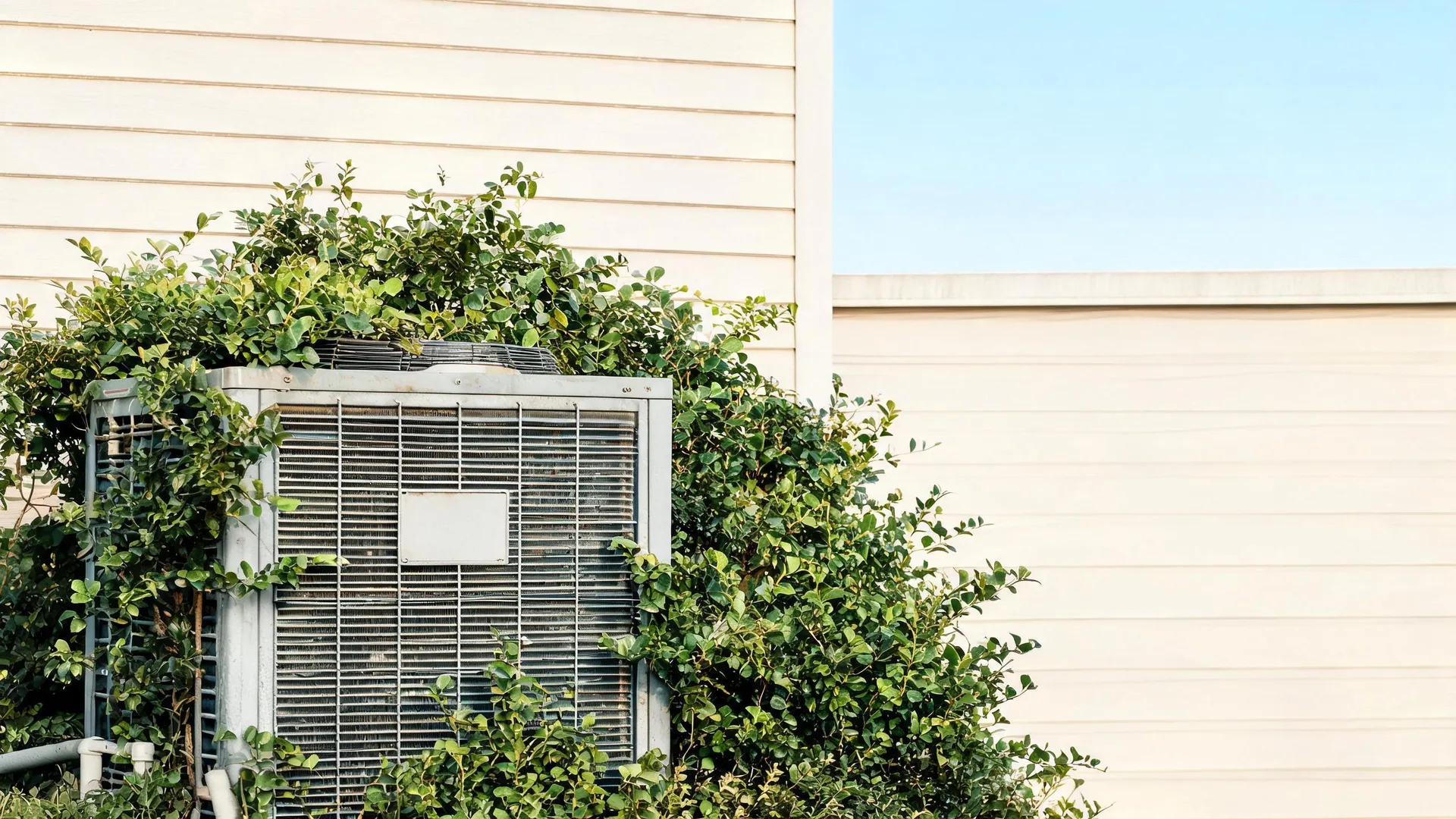
It's making a noise it didn't used to make

Banging, grinding, or a loud click when the system switches between heating and cooling are worth paying attention to. A grinding or squealing sound usually points to a fan motor bearing going bad. Banging inside the outdoor cabinet can mean a loose or broken part knocking around. A heat pump that suddenly sounds different is telling you something changed, and running it longer usually makes that part worse.

Most heat pump failures start with the reversing valve, the part that switches the system between heating and cooling. It can get stuck partway, so the system runs but can't fully switch modes. The compressor itself usually fails for a reason upstream of it, a low refrigerant charge, a dirty outdoor coil choking airflow, or a failed capacitor that makes the compressor strain every time it tries to start. Defrost control is another common spot. A heat pump is supposed to melt frost off the outdoor coil on a cycle, and when the defrost board or sensor fails, ice builds up until the unit can't pull heat from the air at all. Fan motors wear out the plain way, the bearings go, and the motor keeps running rough until it seizes.

A diagnostic visit starts outside at the unit, not at the thermostat. A tech hooks up gauges and checks refrigerant pressure on both sides, because that reading points toward or away from most other problems. Electrical testing comes next. The capacitor, the contactor, and the compressor windings all get checked to see if they're drawing power the way they should. The reversing valve gets tested under power too, since a valve stuck partway can look like a failed compressor from the outside. If there's frost or ice on the outdoor coil, that changes the order of things, because the defrost board and sensor need checking before anything else makes sense. None of this is guesswork. Each test rules something out until what's left is the actual failure.