





Single-story brick and white-sided buildings with covered porches behind a trimmed hedge and lawn, framed by overhanging oak branches draped with Spanish moss.

Heat Pump Repair in Batesville, AR

Tell us about the job

Takes about a minute. No obligation.

RepairHeat PumpIndependence County, AR
Step 1 of 2

What ZIP code is the job in?

May is when cooling starts here, and that first stretch is when a weak heat pump shows its problems. A capacitor or contactor that was barely getting by in April won't hold up once the system is running every day. Same thing in reverse come October, when the heat pump switches over and a weak part that made it through summer finally gives out. If yours is struggling right at the start of one of these stretches, that timing is not a coincidence. Getting it looked at now, rather than waiting, means fixing the actual cause instead of running a strained system through the next several months.

7 months
October through April, your system heats
5 months
May through September, it cools
31°F
the average winter night it heats against
89°F
the average summer afternoon it cools against
Isometric line illustration of a cutaway house showing interior rooms with furniture, a furnace or air handler with overhead ductwork, and an outdoor condenser unit connected by lines outside the wall.
Your system heats October through April and cools May through September.

NOAA nClimDiv, 1991–2020 normals

Check the thermostat mode and the batteries before anything else.

A heat pump that won't switch between heating and cooling is often stuck on a setting, not broken.

Half the homes in Independence County were built in 1988 or later

Half the homes here were built by 1988
Power costs 12.32 cents a kWh statewide
Climate zone 3A

Get it looked at early

Problems tend to show up in the first weeks of the season, when the load hits a part that was already weak.

Find a contractor
A gray heat pump outdoor unit mounted on a concrete pad next to a residential house with lap siding and stone accents.

Running it longer doesn't buy you time

A heat pump that's struggling still moves heat, just with something working harder than it should. A weak capacitor makes the compressor draw more current every time it starts. Low refrigerant makes the compressor run hotter than it's built for. Keep running it that way and the wear lands on the compressor itself, which is the one part that turns a repair into a replacement. A failing run capacitor is a part swap. A compressor with months of overheating behind it often isn't. Ice on the outdoor coil works the same way. A little is normal. If the defrost cycle isn't clearing it and the system keeps running anyway, that buildup blocks airflow and the compressor ends up working against a coil that can't do its job. None of this fixes itself by running longer.

The reversing valve is the part unique to a heat pump

The reversing valve switches the system between heating and cooling, and a standard air conditioner doesn't have one. When it sticks, the heat pump can get stuck in one mode, blow air that's not the right temperature, or run without actually switching over when the thermostat calls for it. A stuck reversing valve is one of the more common reasons a heat pump acts up right at the start of a season, since that's when it's first asked to switch after months of sitting in one position.
The outdoor coil works year round, in both directions

A heat pump's outdoor coil carries heat in summer and winter both, so anything fouling it hurts the system no matter the season. A coil caked with dirt, leaves or grass clippings can't transfer heat the way it needs to, and the compressor works harder to make up for it. Over time that shows up as longer run times and a compressor that's logged a lot of hours working against resistance it shouldn't have had.

A heat pump in trouble usually tells you in small ways first. Air coming out the vents that's lukewarm instead of warm, or warm instead of cold, often means the system is running but not actually moving heat the way it should. Short cycling, where it kicks on and off every few minutes instead of running a full cycle, puts a lot of wear on the compressor and usually points to a sensor or airflow problem rather than something you can wait out. A hissing or bubbling sound near the outdoor unit can mean refrigerant escaping, and that's not something that fixes itself. So can a system that runs constantly without ever seeming to catch up to the thermostat. Any of these is worth a call before the next one shows up.

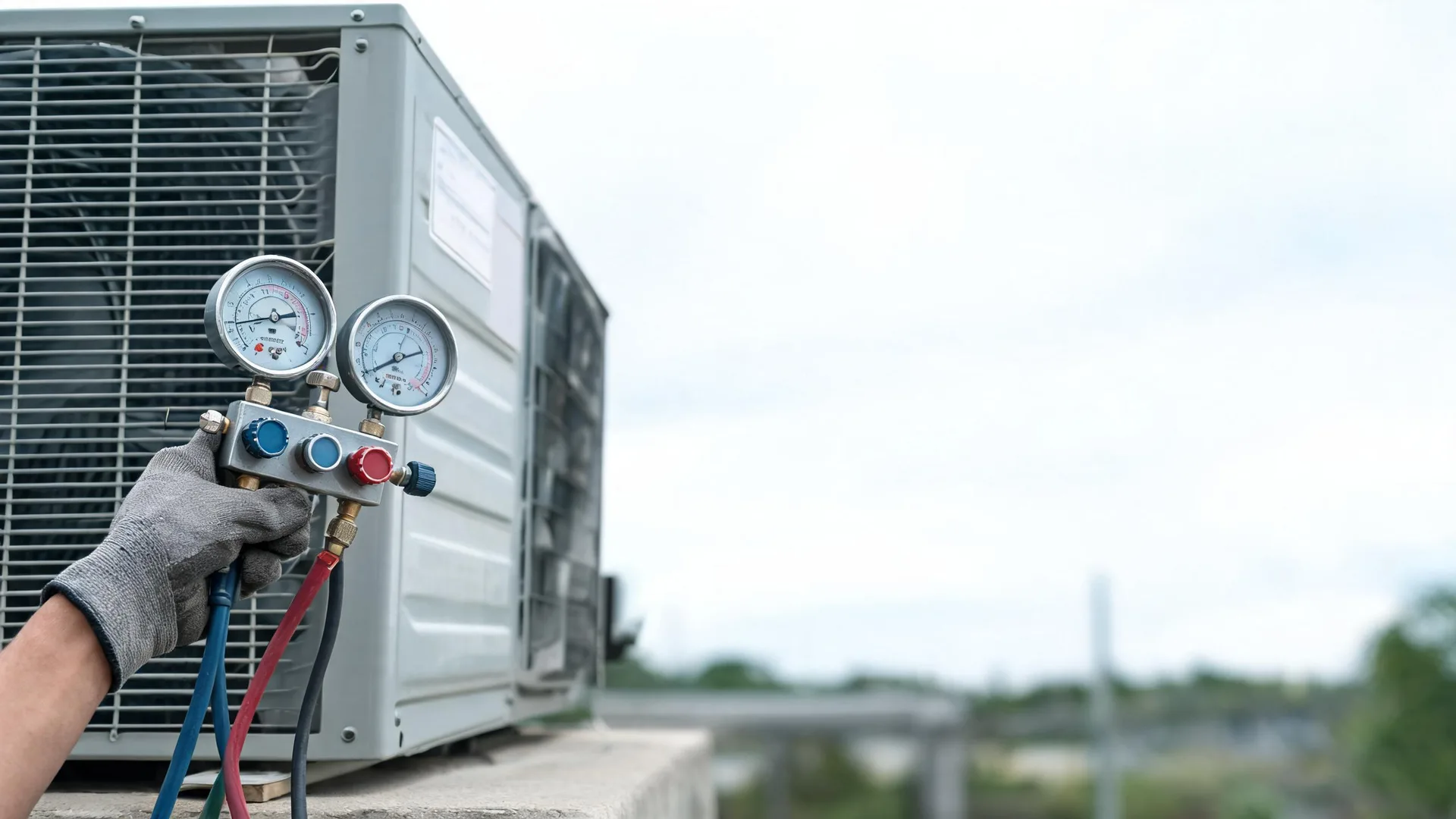
A diagnostic starts outside, with gauges hooked to the refrigerant lines and a look at the coil and the reversing valve. Inside, the tech checks the air coming off the vents against the air going into the return. That difference says a lot about whether the system is actually moving heat. The capacitor and contactor get checked too, along with how the compressor draws current on startup and while it runs. Static readings only go so far, so the system usually gets run in both heating and cooling to see where it actually fails. That's how a stuck reversing valve gets told apart from a low charge, or a bad sensor gets told apart from an airflow problem, since more than one of these can look the same from inside the house.