




Low-angle view along a red brick wall with flowering pink shrubs at its base, a mown lawn extending to a distant single-story house and tall pine trees under an overcast sky.

Heat Pump Repair in Arkadelphia, AR

Tell us about the job

Takes about a minute. No obligation.

RepairHeat PumpClark County, AR
Step 1 of 2

What ZIP code is the job in?

A heat pump here switches from heating to cooling and back as the months turn, and that switch is when weak parts tend to give out. Heat runs November through March, so by October a tired part has already made it through a full season of work. Cooling starts in May, and whatever was marginal at the end of summer is still marginal when it has to start pulling that load again. A low charge or a failing capacitor can limp through the mild weeks between seasons without causing trouble. The first hot stretch or the first cold snap is what finds it.

5 months
November through March, your system heats
5 months
May through September, it cools
33°F
the average winter night it heats against
91°F
the average summer afternoon it cools against
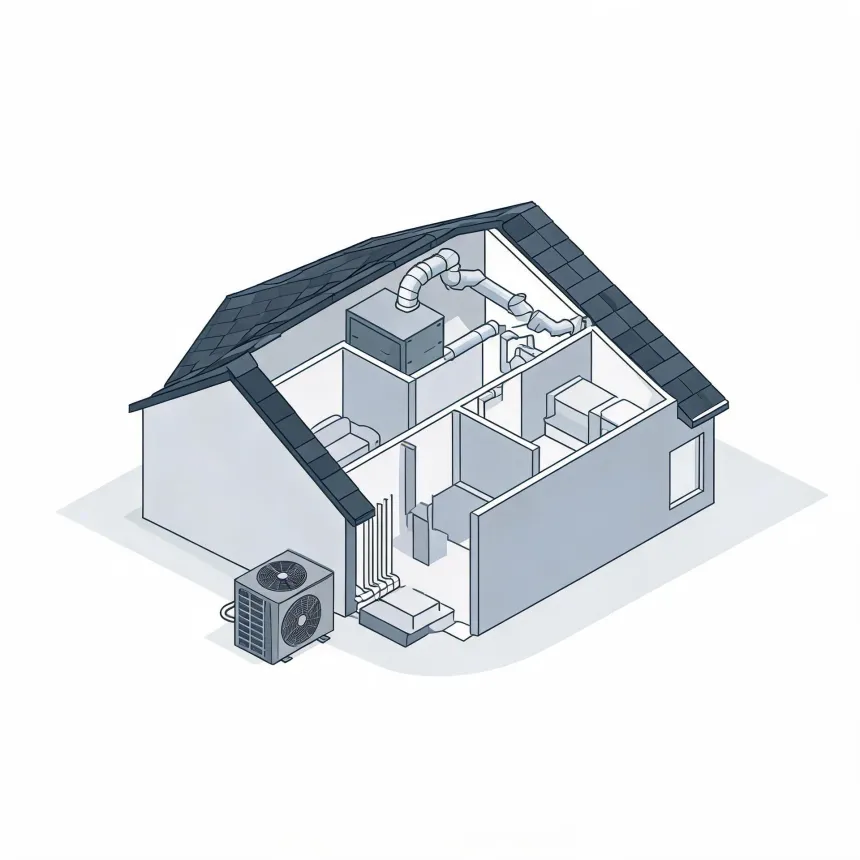
Isometric line illustration of a cutaway house showing interior rooms, an air handler with ductwork in the attic space, and an outdoor condenser unit beside the exterior wall.
Your system heats November through March and cools May through September.

NOAA nClimDiv, 1991–2020 normals

A heat pump that runs constantly but never quite gets the house to temperature usually points to a charge problem, not a thermostat setting.

A low charge found early is a quick fix. Left alone, it strains the compressor until that part fails too.

Half the homes here were built in 1985 or later, and a heat pump that age is usually worth fixing

Half the homes here were built by 1985
Power costs 12.32 cents a kWh statewide
Climate zone 3A
A newer heat pump is a repair, not a replacementHalf the homes in Clark County were built in 1985 or later

A heat pump has one part that is expensive to replace and everything else is cheap by comparison. That part is the compressor. If a contractor finds a bad capacitor, a failed fan motor, or a stuck reversing valve, that is a repair, done in one visit, and the system goes back to running like it did before. If the compressor itself is failing, the math changes, because that single part can cost as much as a large share of a new system, and paying that much to put it into an old outdoor unit does not make sense. Age matters here too. A unit still under warranty is worth repairing almost no matter what broke. A unit well past its expected life that needs a second or third major repair in a few years is telling you something, even if this particular fix is affordable. The question is never just what this repair costs, it is whether the unit is worth repairing again next year.

Get it looked at early

Problems tend to show up in the first weeks of the season, when the load hits a part that was already weak.

Find a contractor
A white mini-split heat pump outdoor unit mounted on a concrete pad beside a gray-sided house, surrounded by gravel and green shrubs.

Running it while it struggles wears down the one part you can't patch

A refrigerant leak does not fix itself. The charge is already low, and every hour the compressor runs on a low charge it works harder than it was built to and runs hotter than it should. That heat breaks down the oil that is supposed to protect the motor windings. Keep running it and a leak that could have been sealed turns into a dead compressor. A failing capacitor follows the same pattern. The motor can still start, weak and slow, but it pulls more current doing it, and every one of those starts stresses the windings a little more. Shut the system down when you notice it struggling and a tech swaps the part. Let it keep starting that way and the motor itself can give out. The same holds true anywhere a part is working outside what it was built for. The longer it runs that way, the more load lands on the compressor, and that is the part you want to keep out of trouble.

Check the thermostat first

Make sure it is set to heat or cool as needed and the batteries are not dead. Bump the setpoint a few degrees past room temperature and listen for the outdoor unit to kick on. If the screen is blank or it will not hold a setting, that is the fix right there.
Look at the air coming out of the vents

Weak airflow or air that smells musty usually means a dirty filter, and a clogged filter can make a heat pump run constantly without heating or cooling the house. Check the filter and replace it if it is gray or caked. If the air is cold during a heating cycle, that is a different problem, and nothing a homeowner can check will explain it.

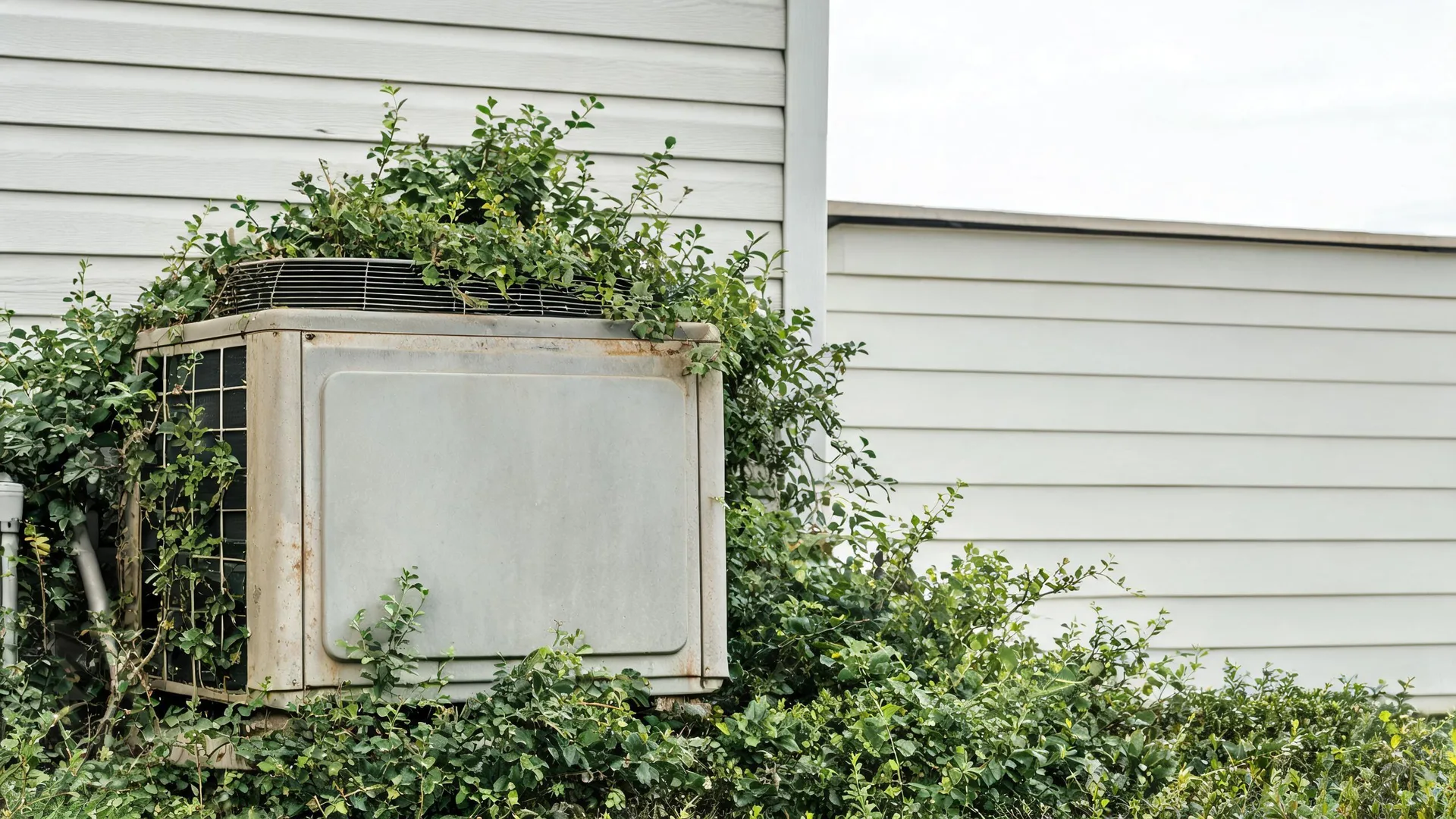
The capacitor is usually the first thing to go. It gives the compressor and fan motors the jolt they need to start, and it weakens with age and heat until a motor hums instead of starting, or doesn't start at all. The reversing valve is what switches the system between heating and cooling, and if it sticks, the unit blows cold air when it should heat or runs both at once. A slow refrigerant leak at a fitting or coil shows up as a system that runs constantly without closing the gap on the thermostat. Outdoors, the coil and fan take the brunt of the weather. A coil caked with dirt or choked by leaves can't shed heat properly, and a fan motor that's worn or seized stops moving the air that coil depends on. None of these start as emergencies. They start as a unit working harder for a little less result, until the part gives out completely.

A diagnostic visit starts outside, at the unit itself. A tech checks the refrigerant charge with gauges, because a system can look fine and still be low. They'll test the capacitor under load rather than just eyeballing it, since a weak one can still pass a glance. The contactor and wiring get a check too, looking for pitting or a connection that's gone loose from vibration. Inside, they'll check the air handler for a frozen coil or a filter that's been restricting airflow longer than anyone noticed. If the system is stuck in one mode, the reversing valve gets tested directly, since that's the part that decides whether the house gets heat or cold air. By the end, the tech should be able to point to the one part that's actually failing, not just the symptom it's causing.