Poinsett County sees a lot of severe weather
103 severe weather events hit the county between 2015 and 2024, among them damaging wind, hail and tornadoes. An outdoor condenser sitting in the open takes all of it directly.
Takes about a minute. No obligation.
103 severe weather events hit the county between 2015 and 2024, among them damaging wind, hail and tornadoes. An outdoor condenser sitting in the open takes all of it directly.
Where the outdoor unit goes and what shields it from wind-blown debris and hail is worth working out before installation, not after. Nearly a quarter of Arkansas households lost power for a day or more in 2024, so it's also worth asking what happens to your heat or hot water when the lines go down.
NOAA nClimDiv, 1991–2020 normals
Electricity heats about half the homes in Poinsett County, split between heat pumps and electric furnaces or baseboard.
A mini split is an electric heat pump, so it fits the setup most homes here already have.




Half the homes in Poinsett County were built in 1978 or earlier, half in 1978 or later. That split doesn't call for anything special in a mini split. A unit sized to the room it's heating and cooling, at a standard efficiency rating, does the job whether the house is old or new. What matters more is the condition of what's already there. The electrical panel, the wall where the indoor head will mount, the path for the line set to the outdoor unit. A contractor sizing the job will look at the space itself, not the year the house went up.
Poinsett County falls in climate zone 3A, and the federal standard treats a ductless mini split as a split-system heat pump. Units made from 2023 on have to hit at least 14.3 SEER2 for cooling and 7.5 HSPF2 for heating. That sets the floor for what a contractor can install. A federal tax credit is available on top of that for systems that qualify.
Find a contractor
A mini split runs on the same questions however many brands you put in front of it. Ask what load calculation was done on the room, not just what capacity the equipment is rated for off a chart. A unit sized to a square footage guess and one sized to the actual room can carry the same efficiency rating and still perform differently once installed. Ask how many indoor heads the outdoor unit is meant to carry and whether it holds steady if all of them run at once. Ask whether the compressor runs at a fixed speed or adjusts itself to the load, since that changes how the system behaves on a mild afternoon versus the hottest day it sees. Ask what the warranty covers on the compressor separately from the rest of the system, since that's the part most likely to fail expensively. None of this shows up on the price tag. All of it shows up in how the system runs once the crew is gone.
A single indoor head cooling one room costs less to install than a system feeding several heads off one outdoor unit. Each added zone means another line set run, another mounting job, another spot on the wall to get right. Pricing a mini split means pricing the number of rooms it has to reach, not just the equipment.
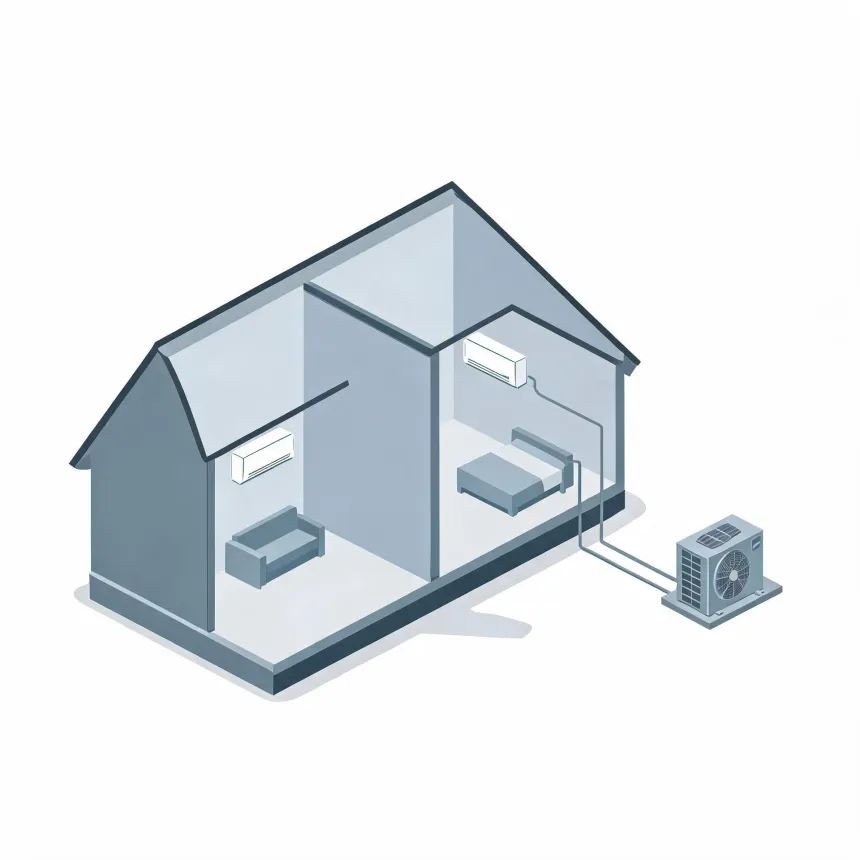
The refrigerant line runs from the outdoor unit to each indoor head, usually through a hole drilled in the wall behind it. A straight shot through an exterior wall is quick work. A run that has to go up through an attic, across a soffit, or down an outside wall to reach where the condenser sits takes longer and uses more material. Where the outdoor unit can go relative to the indoor head affects the job as much as the equipment does.
SEER2 and HSPF2 are ratios, not a size. SEER2 measures cooling output against the electricity it takes to produce it, and HSPF2 does the same for heating. A higher number means the unit gets more cooling or heating out of the same power, not that it cools or heats a bigger space. Mini splits carrying the same rating can still perform differently from room to room if one is sized wrong for the space it's in. The rating only describes how efficiently the unit turns electricity into comfort once it's doing the right amount of work. Whether that efficiency actually shows up on the power bill comes down to sizing, which is a separate question from the one on the label.
Installation day starts with the spots already picked out, the indoor head on its wall bracket, the outdoor unit on its pad or mount. The crew drills through the wall for the line set. The refrigerant lines, the condensate drain, and the electrical whip all run through that same opening, then it gets sealed against weather. Lines get connected at both ends, and the system is pressure tested before any refrigerant goes in. That catches a bad flare fitting or a loose connection while it is still easy to fix. Once that holds, the line gets charged and the system runs through its paces. Cooling, heating, fan speeds, the thermostat or remote talking to the head the way it should. A straight line set through one wall is usually a one day job. Add more zones or a longer run around the house, and the day stretches out, since each indoor head needs its own line set, its own drain, and its own spot on the wall done right.