Two white Southern-style homes with wraparound porches lit by landscape lighting at night, flanked by live oak trees hung with Spanish moss.

Mini Split Installation in Ozark, AR

Tell us about the job

Takes about a minute. No obligation.

New system or replacementMini-splitFranklin County, AR
Step 1 of 2

What ZIP code is the job in?

Electricity here runs cheap

Arkansas households paid 12.32 cents per kilowatt-hour in 2024, below what most of the country pays. A mini split still costs less to run than old electric resistance heat or a window unit, but the gap in your bill matters less here than it does somewhere with expensive power.

Pick the unit that will last, not just the one rated highest

When power is cheap, a higher SEER2 number takes longer to earn back its extra cost. Put the weight on which system holds up through an Ozark summer and a hard freeze, and which contractor will show up to service it, over chasing the top efficiency rating.

7 months
October through April, your system heats
5 months
May through September, it cools
31°F
the average winter night it heats against
89°F
the average summer afternoon it cools against
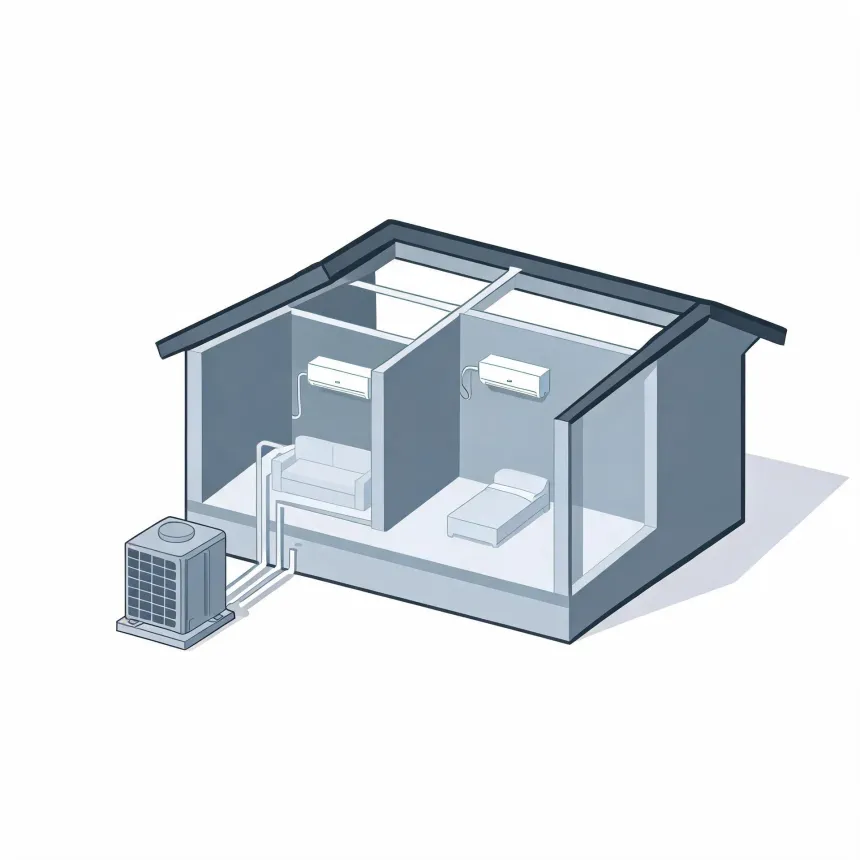
Illustrated cutaway of a two-room house showing two wall-mounted indoor air conditioning units connected by pipes to an outdoor condenser unit on the ground outside.
Your system heats October through April and cools May through September.

NOAA nClimDiv, 1991–2020 normals

Ozark runs five months of cooling, May through September, with afternoon highs averaging 89.

A mini split here has to handle a long, hot stretch every year, not just a few sharp afternoons.

May through September, it runs. Put it in before the first one.

Cooling runs May through September
Summer afternoons average 89°F
88 damaging wind events from 2015 to 2024

Most homes in Franklin County heat with electricity, 62.9% of them. Gas comes in well behind, at 28.5%. That matters if you're adding or replacing a system here, because a lot of these houses already have electric baseboard or an electric furnace, and a mini split fits right alongside that setup. Swapping straight electric heat for one or more mini split heads is a common path here for that reason. If your home runs on gas instead, a mini split still handles the cooling side and can carry the shoulder season, but it's working alongside what you have, not replacing it.

Any system installed here has to clear 14.3 SEER2 and 7.5 HSPF2

Franklin County falls under zone 3A, and a ductless mini split counts as a split system under the federal standard. New units manufactured from 2023 on have to hit 14.3 SEER2 for cooling and 7.5 HSPF2 for heating, no matter where you buy one. That floor also unlocks a federal tax credit on qualifying equipment. It narrows what a contractor can offer you, which makes this a good time to get a system sized and quoted for your home.

Find a contractor
A man seen from behind in a dark shirt and tan work pants carries a canvas tool bag up wooden steps toward a green front door of a shingled house.
A white outdoor air conditioner condenser unit mounted on metal wall brackets against gray horizontal siding, with a blue sky and white clouds behind it.

Sized for a long summer, not a guess

Five months of cooling a year, with afternoons near 89, means this system runs long stretches without a break. Get it sized for your home instead of going with whatever's on the truck. A unit too small will run constantly and still fall behind on the hottest afternoons. One too large cycles on and off and never runs long enough to pull the humidity down. Either way, parts wear sooner than they should.

Ask what the load calculation found

A contractor should measure your home room by room before naming a unit, not size it off square footage alone. That calculation accounts for window placement, wall insulation, and ceiling height, and it decides how many heads you need and where they go. If nobody measured, the quote is a guess.

Ask who services the brand locally

A mini split needs its filters cleaned and its outdoor coil kept clear for as long as you own it, and at some point it will need a refrigerant check or a board replaced. If the installer can't get parts for that brand or isn't still around in a few years, you're stuck finding someone else who knows the system.

A load calculation is what keeps a mini split from being a guess. It looks at how much heat moves through your walls, your windows, your roof, and how much heat your home gives off from the inside, then matches that against what a given unit can actually move. Skip that step and you end up sizing off square footage alone, which ignores all of it. Oversize the unit and it short cycles, shutting off before it ever pulls the moisture out of the air, so the room feels cool but damp. Undersize it and the compressor runs flat out on the hottest afternoons and still can't keep up. Either way the compressor is working outside the conditions it was built for, and that's what shortens its life.

Installation starts outside, with the outdoor unit set on a pad or mounted bracket where air can move freely around the coil. Inside, each head gets mounted high on a wall or ceiling, over the spot the contractor picked during the load calculation, not wherever looks convenient. A small hole goes through the wall to run the line set, the pair of copper lines that carry refrigerant between the indoor and outdoor units, along with a drain line and electrical wiring. Once the lines are connected, the system gets evacuated with a vacuum pump to pull out moisture and air before any refrigerant moves through it. Skip that step and moisture left in the lines can damage the compressor down the road. After that, the contractor charges the system, checks the drain line flows downhill the whole way, and confirms each head is reading temperature right before calling the job done.