A row of single-story houses with covered porches, the nearest clad in red brick, seen behind a trimmed hedge and lawn beneath large moss-draped oak branches.

Mini Split Installation in Mountain Home, AR

Tell us about the job

Takes about a minute. No obligation.

New system or replacementMini-splitBaxter County, AR
Step 1 of 2

What ZIP code is the job in?

The old equipment has to come out

Whatever heated or cooled the space before, whether it was a window unit, baseboard heaters, or an older central system, the installer disconnects it and hauls it away. If it ran on its own circuit or line, that gets capped or repurposed as part of the job.

Removal is part of the install, not a separate project

A mini split installer plans for teardown alongside the new setup. Old wiring, abandoned refrigerant lines, or a dead condenser outside all get cleared so the new lineset and wiring have a clean path in.

7 months
October through April, your system heats
5 months
May through September, it cools
28°F
the average winter night it heats against
88°F
the average summer afternoon it cools against
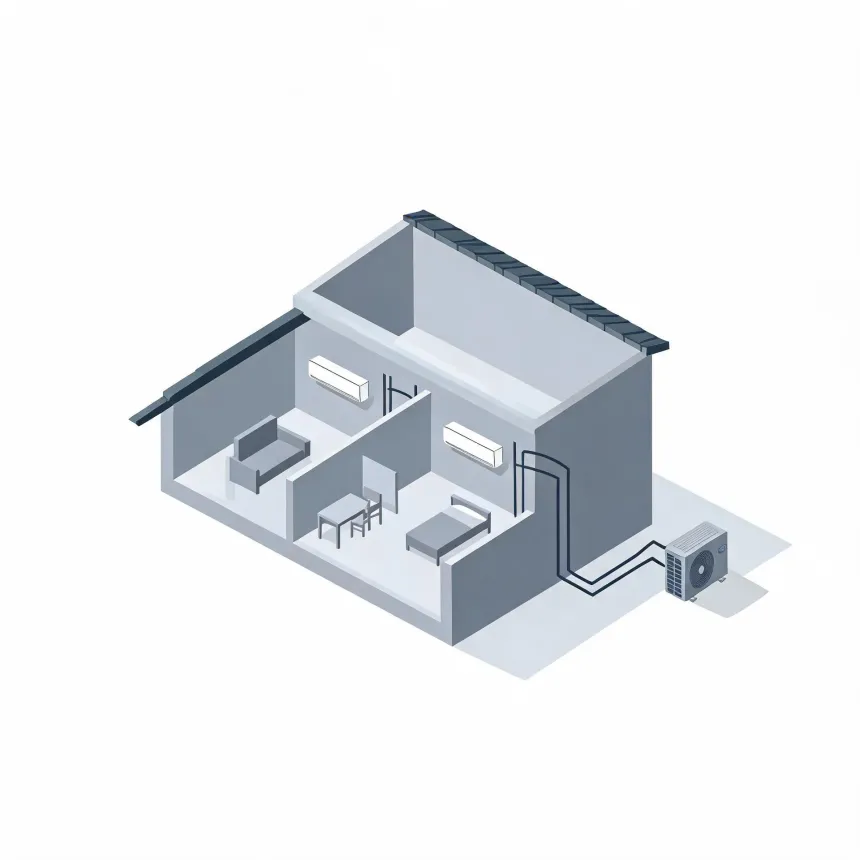
Isometric cutaway illustration of a gray house showing two wall-mounted indoor air conditioning units in separate rooms with furniture, connected by line sets to an outdoor condenser unit on a pad outside.
Your system heats October through April and cools May through September.

NOAA nClimDiv, 1991–2020 normals

Arkansas electricity ran 12.32 cents a kilowatt-hour in 2024, cheaper than most states.

A mini split still costs less to run than baseboard heat or window units, but don't expect it to pay for itself fast here.

Put a mini split in before May, so it's running before the heat is

Cooling runs May through September
Summer afternoons average 88°F
46 hail events from 2015 to 2024
Electricity heats Baxter County53% of homes here run on electricity, more than any other fuel.

Baxter County has logged 114 severe weather events over the past ten years, and damaging wind and hail make up most of them. An outdoor condenser sits right in the path of both, so where the installer mounts it matters. A pad or bracket off to the side, clear of branches and clear of where hail comes straight down off a roofline, holds up better than one tucked under the eaves. Power cuts matter too. Close to a quarter of Arkansas households went at least a day without power last year, and a mini split won't run without it, same as central air. Some homeowners here pair the install with a generator hookup so at least one zone keeps running when the lines go down.

A standard mini split is right for this house

Cooling here runs May through September, with afternoon highs averaging 88°F in June, July and August. That's a normal five-month season, nothing a standard size and efficiency can't handle. There's no reason to size up or pay for extra capacity this house won't use.

Find a contractor
A man in a dark shirt and tan work pants, seen from behind, carries a canvas tool bag up wooden porch steps toward a green front door of a shingled house with a potted shrub beside it.
A beige split-system air conditioner outdoor condenser unit mounted on metal wall brackets atop a stucco wall.

The install price follows the distance and the difficulty, not the equipment

What a mini split costs to put in comes down to how far the indoor and outdoor units sit from each other, how many zones the system needs to cover, and what the installer finds once the walls are open. A short lineset run between indoor head and outdoor condenser is the cheapest path. Every extra foot of lineset, every wall it has to pass through, every floor it has to drop down, adds labor and material. A single zone system is more straightforward than a multi-zone setup where one outdoor unit feeds several indoor heads, since each added zone means another lineset run and another spot to mount and level. Electrical work moves the number too. Some homes have a circuit nearby that can be adapted, others need a new line run from the panel, and that gap in difficulty shows up in the bid. Mounting matters as well. A condenser going onto level ground near the wall is simple. One that needs a raised pad, a bracket off a ledge, or a longer path to clear obstructions takes more time to set right. None of this is guesswork once an installer walks the site. The quote reflects what the job actually requires, not a flat rate for a box on the wall.

The rating tells you the ratio, not the bill

The efficiency number on a mini split measures how much heating or cooling it produces for the power it draws. A higher rated unit gets more out of the same electricity than a lower rated one. It doesn't tell you what you'll pay, because that depends on how much the system runs and what the utility charges for power. Homes running the same rated unit can still see different numbers on their bill.

The install is what makes the rating real

The rating comes from testing the equipment under fixed conditions in a lab, not from the walls it ends up mounted in. A mini split only reaches that number when the lineset length, the refrigerant charge, and the airflow at the indoor head are all set the way the equipment calls for. A unit straining to cover too much space, or one fed by a lineset run longer than it's rated for, won't perform at its labeled efficiency no matter how high that number is.

When you're comparing quotes, ask what each system is rated for at low temperatures, not just its efficiency number. Some mini splits lose heating capacity as the outdoor air gets colder, and a unit that struggles below freezing will lean hard on backup heat strips if it has them, or fall short if it doesn't. Ask about the sound rating for the outdoor condenser too, since some run noticeably quieter than others at the same capacity, and that matters if it's going near a bedroom window or a patio. Ask what happens if a single indoor head fails in a multi-zone system. On some systems the rest keep running, on others the whole outdoor unit shuts down. And ask who services the brand locally. A system backed by a manufacturer with few trained installers nearby can leave you waiting if a part needs replacing under warranty.

Install day starts outside, mounting the condenser on its pad or bracket before anyone touches the inside wall. Once that's set, the installer drills a single small hole through the wall for the lineset, the refrigerant lines, power wire, and condensate drain bundled together and run through one opening. That hole gets sealed once everything passes through, so weather and pests stay out. Inside, the indoor head goes up on a mounting plate, and the installer checks it's level before running the lineset back to the condenser. The lines get connected, then the system is evacuated with a vacuum pump to pull out moisture and air before any refrigerant moves through it. Skipping that step is how a system ends up with a slow leak or a compressor that fails early. Once the vacuum holds, the refrigerant valves open, the installer checks the charge, and the system runs through a cycle on both heating and cooling before anyone calls the job done.