A tabby cat sleeps on a dark quilted bed in a moody, minimalist bedroom with a black wall-mounted air conditioning unit.

Mini Split Installation in Mena, AR

Tell us about the job

Takes about a minute. No obligation.

New system or replacementMini-splitPolk County, AR
Step 1 of 2

What ZIP code is the job in?

Most of Mena heats with electricity

Electricity heats 59.1% of homes in Polk County. Gas service reaches far fewer, with utility gas at 17.7% and propane at 8.6%. A mini split fits into that pattern instead of working against it, since it runs on electricity like the furnace or heat strips it would replace.

No gas line to plan around

With most homes here already wired for electric heat, a mini split installation does not need a new gas line or venting for combustion. The work centers on the electrical circuit, the indoor unit placement and the line set to the outdoor unit, not on connecting to a fuel this area rarely uses.

7 months
October through April, your system heats
5 months
May through September, it cools
31°F
the average winter night it heats against
89°F
the average summer afternoon it cools against
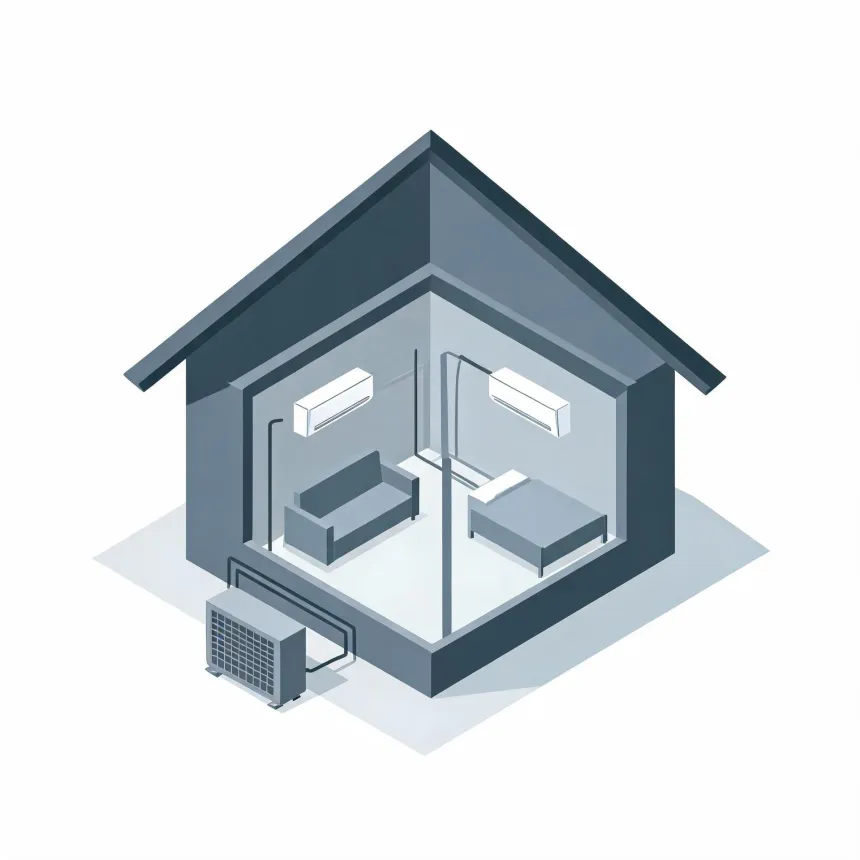
Isometric cutaway illustration of a small gray house showing two rooms, one with a sofa and one with a bed, each with a wall-mounted indoor air conditioning unit connected by line sets to an outdoor condenser unit on the ground outside.
Your system heats October through April and cools May through September.

NOAA nClimDiv, 1991–2020 normals

The outdoor unit size has to match the room it's heating and cooling, not round up for safety.

An oversized unit cycles on and off fast and never runs long enough to pull moisture out of the air.

Cooling starts in May, so get it installed before April is out

Cooling runs May through September
Summer afternoons average 89°F
Power costs 12.32 cents a kWh statewide

Polk County gets its share of rough weather. Seventy severe weather events over the past ten years, mostly wind and hail, with a tornado and a few winter storms mixed in. None of that changes what size mini split this house needs. A unit sized to the room handles a cold snap or a hot stretch the same way a furnace or heat strips would, and storms here don't call for bigger equipment or a different kind of system. What they do affect is the power behind it. A mini split runs on electricity, and when the power is out, it's off, same as any electric heat. Close to a quarter of Arkansas households lost power for a full day or more last year. That's worth planning around if backup power matters to you, but it's not a reason to size the unit any bigger than the room calls for.

Any system installed here has to meet zone 3A minimums

Polk County is in climate zone 3A. A mini split counts as a split-system heat pump under federal rules, so any unit installed here has to hit 14.3 SEER2 for cooling and 7.5 HSPF2 for heating. That's the floor, not a suggestion. A federal tax credit is available on top of that for equipment that qualifies.

Find a contractor
A white mini-split air conditioner outdoor condenser unit mounted on metal brackets against a beige stucco exterior wall, with a blue sky and scattered clouds in the background.

Sized once, it runs that way every day after

Sizing a mini split starts with a room by room heat loss and heat gain calculation, not square footage alone. A tech works out how fast a room loses heat in the cold and gains it in the sun, accounting for window area, insulation, ceiling height and what's on the other side of each wall. Rooms that look the same size on paper can call for different size units once sun and glass and exposure are counted in. Running the system day after day is what exposes a size that was guessed instead of calculated. An oversized unit satisfies the thermostat fast, shuts off, and starts again a short while later. That short cycling never lets the system settle into a steady run, and a house can feel clammy in the cooling months because the unit never ran long enough to pull the moisture out of the air. An undersized unit shows the opposite problem, running close to constant on the hardest days and still falling behind, the compressor working flat out for hours at a stretch. Either mistake wears on a system that otherwise has no belts or pulleys to fail, just a compressor and fan motors built to run long, steady cycles for years.

Ask how many zones, not how many rooms

A mini split system can run one indoor head or several off the same outdoor unit, and that changes the quote. One outdoor unit split across too many zones runs out of capacity on the coldest or hottest days, with every head competing for the same compressor. Ask how many zones the outdoor unit is rated for and whether the one being quoted is already near that limit.

Ask what happens to the old line set

If a mini split is going in where ductwork or an old system already exists, ask whether the line set connecting indoor and outdoor units is new or reused. A line set sized for a different unit, or one with a bad flare fitting, bleeds refrigerant slowly, and a system low on charge loses capacity and runs longer than it should to hit the same temperature.

The SEER2 and HSPF2 numbers on a mini split's label tell you how much heating or cooling the unit squeezes out of the electricity it uses. A higher rating means the compressor and fan are doing more work per watt, nothing more than that. It says nothing about whether the unit is sized right for the room it's heating or cooling. A unit with a high rating but the wrong capacity still short cycles or still runs flat out, and either way the rating on the box stops meaning much once it's on the wall. That rating also assumes the line set was sized correctly and the installation was done to spec. A bad flare fitting or a slow refrigerant leak drags real performance below what the label promised, and the compressor ends up working harder to make up for lost charge. Units with the same rating can run very differently for years depending on whether the charge was set correctly on install day.

Install day starts with the outdoor unit placement and the line set route, since both get decided before anything is mounted. The outdoor unit needs clearance on all sides for airflow and a spot where condensate can drain away from foundations or walkways. Indoors, the mounting plate goes high on a wall with a clear path for the line set to reach outside, usually through a small hole drilled at a slight downward angle so condensation runs out instead of back in. Once the indoor head is mounted and the line set run, the tech connects the refrigerant lines, flares the fittings, and pulls a vacuum on the system to clear out air and moisture before the charge is released. That vacuum step matters more than it looks. Any moisture left in the lines mixes with refrigerant and oil, and over time it corrodes the inside of the system. After the charge is set, the tech checks line set connections for leaks, confirms the condensate drain is clear, and runs the system through a heating and cooling cycle to make sure it responds to the thermostat the way it should.