






Night view of illuminated white Southern-style houses with wraparound porches beneath Spanish moss-draped oak trees.

Mini Split Installation in Hot Springs, AR

Tell us about the job

Takes about a minute. No obligation.

New system or replacementMini-splitGarland County, AR
Step 1 of 2

What ZIP code is the job in?

The efficiency rating on a mini split tells you how much heat it moves for the power it draws, and a higher rating means lower running cost over the life of the unit. That rating is measured under set conditions in a lab, so it's a way to compare one system against another, not a promise of what you'll see on your own power bill. A unit sized wrong for the room will run worse than its rating suggests, cycling on and off instead of holding steady. The rating also assumes the outdoor and indoor units are matched as a pair and installed the way the manufacturer specifies, with the line set and refrigerant charge done right. Mismatch those parts, or shortcut the install, and you lose the efficiency you paid for even though the rating on the box never changes.

6 months
November through April, your system heats
5 months
May through September, it cools
33°F
the average winter night it heats against
90°F
the average summer afternoon it cools against
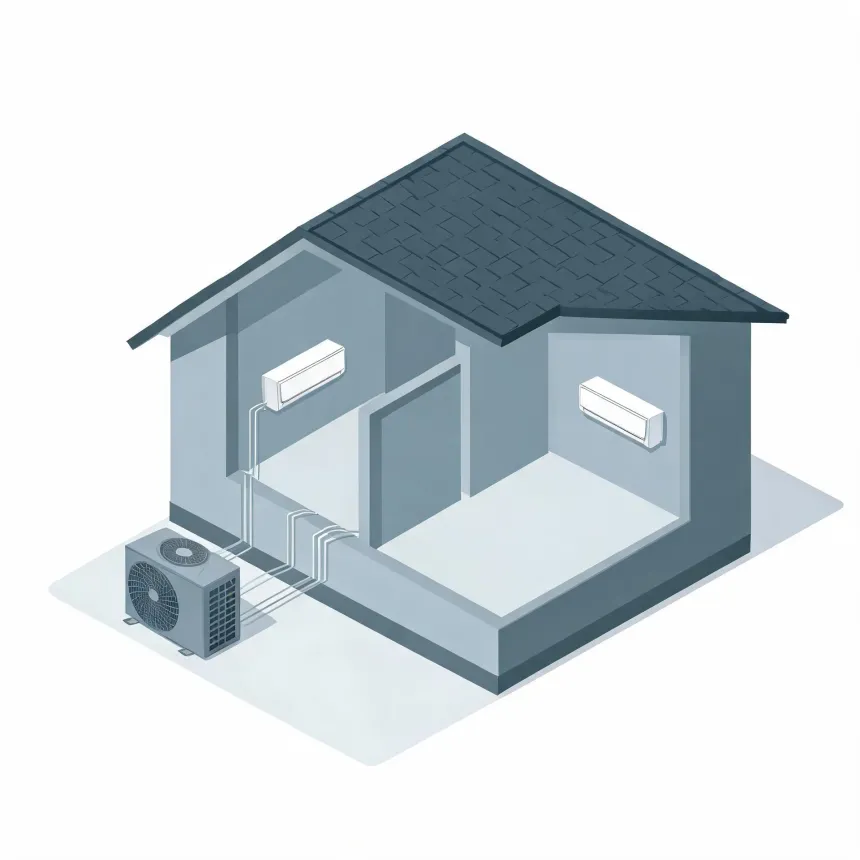
Isometric cutaway illustration of a small house showing two wall-mounted indoor air conditioning units connected by refrigerant lines to an outdoor condenser unit on the ground outside.
Your system heats November through April and cools May through September.

NOAA nClimDiv, 1991–2020 normals

Electricity heats 65.8% of homes in Garland County, more than gas and propane combined.

A mini split runs on electricity already, so it fits the setup most houses here have without any new fuel line.

Power is cheap here, so paying more for a higher efficiency rating takes longer to earn back

Power costs 12.32 cents a kWh statewide
Cooling runs May through September
Summer afternoons average 90°F
Get it in before MayCooling runs May through September here. April is the month to have it done.

Arkansas power runs 12.32 cents a kilowatt-hour, below what most of the country pays. A mini split with the top efficiency rating has less to make up for in lower bills here, so put the money where it holds up longer. Ask for the unit sized right for the room. Ask for a clean line set install and a proper refrigerant charge. Ask whether parts and service are easy to get locally if the unit needs attention years from now. A mid-tier system installed right will outlast a high-end one installed wrong.

Any system installed here has to clear 14.3 SEER2. The credit helps you clear it well.

Garland County falls in climate zone 3A, and any mini split installed here, ductless or not, has to meet 14.3 SEER2 for cooling and 7.5 HSPF2 for heating. That's the floor, not a special ductless category. A federal tax credit is available on top of that for units that qualify, which narrows the real cost of going with a system built to last.

Find a contractor
A man in a dark T-shirt and tan work pants carries a canvas tool bag up wooden porch steps toward a green panelled front door, with a potted shrub beside the entry.
A white outdoor air conditioner condenser unit mounted on metal wall brackets against gray horizontal siding, with a blue sky and white clouds behind it.

Ask how it runs on a mild day, not just a hot one

A mini split runs every time the room calls for it, not on a set schedule, so the outdoor unit may cycle on and off dozens of times a day in mild weather and run steady for hours in a heat wave. Ask how the system behaves at the low end and the high end, not just at the conditions on the spec sheet. Ask what the compressor does in the shoulder months, when it's barely working, versus the worst week of summer, when it's working hardest. A compressor that modulates well across that whole range will hold steady temperatures and wear more evenly than one that's only efficient near the middle of its range. Over years of daily cycling, that difference shows up in the compressor's life and in how often the filter and coil need attention, since a unit that's always ramping up and down pulls more dust through on every restart.

The wall unit is the easy part

The labor is where the money goes. Running the line set between the outdoor and indoor units, finding a clean path through the wall, mounting the condenser on a pad or bracket outside, pulling a vacuum on the line set to purge moisture and air before refrigerant ever flows. A straight, short line set costs less to run than one that has to snake around a corner of the house or climb a floor. Every extra bend and every extra foot of line is more time, more material, and more that can go wrong with the charge.
More zones means more work

A single zone cooling one room is a simpler job than a multi-zone system feeding several rooms off one outdoor unit. Each indoor head needs its own line set run and its own mounting work, and the outdoor unit has to be sized to carry all of them at once without any single room falling short. Deciding how many zones the house actually needs, and which rooms can share comfort well enough to zone together, shapes the job more than which head ends up on which wall.

If the old system is ducted, nobody is required to touch it when a mini split goes in. It can sit there unused, still connected to the ductwork, or it can come out. Some homeowners keep the old furnace or air handler running as backup heat, since a mini split puts out less heat as the temperature outside drops. If the old unit is done anyway, a contractor can decommission it. That means capping the gas line if there is one and pulling the refrigerant out of the old coil. The ductwork can stay sealed off for later or get removed. A mini split doesn't need any of that to work. The old system and the new one don't interact, so what happens to the old one is really just a question of whether it still has any use left in it.

Install day starts outside and inside at once. The indoor head goes up on its mounting plate while the line set gets run through the wall to meet the outdoor unit on its pad or bracket. Before any refrigerant moves, that line set gets pulled down to a vacuum and held there to prove it's sealed, since any moisture or air trapped inside causes problems later that are harder to trace than they are to prevent now. Once it holds, the system gets charged, powered up, and run through both cooling and heat to check that each indoor head responds the way it should. Most of the day is the line set and the vacuum test, not the part you see on the wall when it's done.