A single-story brick house with a dark shingled roof set behind a lawn, framed by pine trees and a large spreading oak, photographed from a low angle with blurred grass in the foreground.

Mini Split Installation in Heber Springs, AR

Tell us about the job

Takes about a minute. No obligation.

New system or replacementMini-splitCleburne County, AR
Step 1 of 2

What ZIP code is the job in?

Most homes here run on electric heat

Electricity heats 59.3% of homes in Cleburne County, more than any other fuel. Gas, whether piped or delivered as propane, heats roughly a third of homes combined. A mini split fits into an electric home without adding a fuel line or venting a new appliance.

What that means for an install here

A mini split replacing electric baseboard or an electric furnace is swapping one electric system for another. The outdoor unit needs its own circuit, and a contractor sizing the job will want to see your home's current electrical panel to confirm it has room.

7 months
October through April, your system heats
5 months
May through September, it cools
31°F
the average winter night it heats against
89°F
the average summer afternoon it cools against
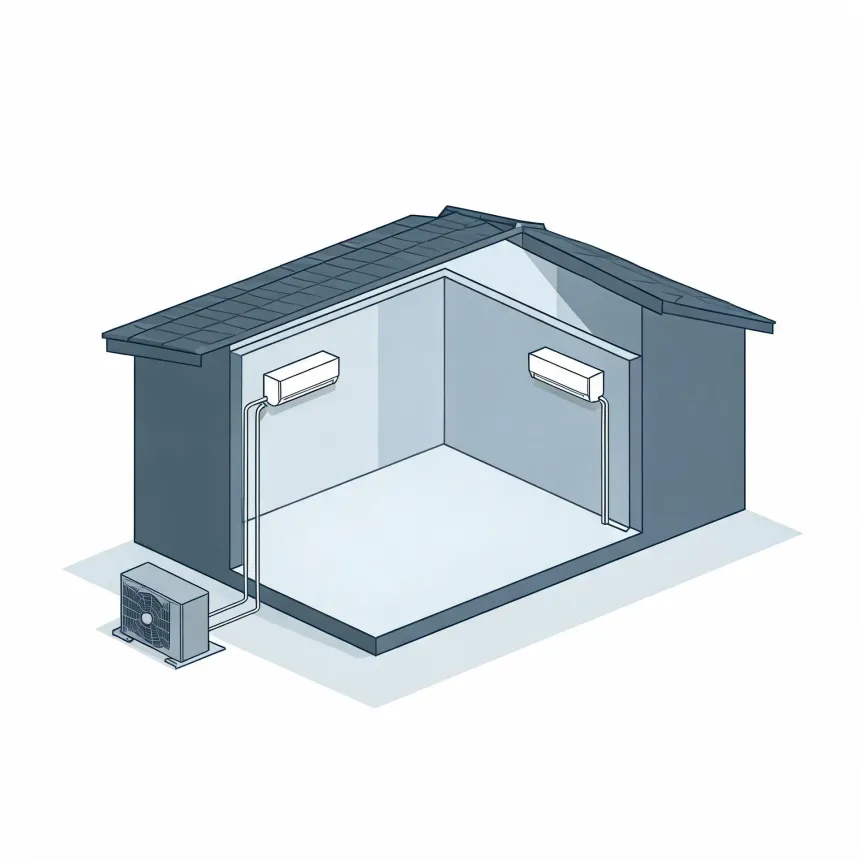
Cutaway isometric illustration of a small building interior showing two wall-mounted indoor air conditioning units connected by line sets running down to a single outdoor condenser unit on the ground outside.
Your system heats October through April and cools May through September.

NOAA nClimDiv, 1991–2020 normals

Cooling here starts up in May and runs five months, through September.

April is when a mini split should already be installed, not when you're getting quotes.

Cheap power here means payback takes longer

Power costs 12.32 cents a kWh statewide
Cooling runs May through September
Summer afternoons average 89°F
Sized for a normal summerAfternoons here average 89°F in June, July and August, nothing a standard mini split can't handle.

Ask how many zones the contractor is proposing and why. Every indoor head needs enough wall or ceiling space, a clear path to the outdoor unit, and a load calculation that accounts for that room's windows and exposure, not a flat number of BTUs per square foot. Ask what happens to the old system, if there is one, and whether its ductwork or electrical gets reused or just abandoned in place. Ask about the line set length and how many bends it needs, since a long or complicated run between indoor and outdoor units affects how well the system performs. Ask who services the unit after installation and whether that includes cleaning the outdoor coil and checking refrigerant charge, since a mini split that never gets maintained loses efficiency the same way any other system does.

Pick the install that's done right, not the rating on the box

At 12.32 cents a kilowatt-hour, a high-efficiency model takes longer to earn back the difference in price. Put the weight on getting the sizing and installation right, and lining up who services the unit after, since that is what decides how well it runs.

Find a contractor
A man in a dark cap and jacket, seen from behind, climbs porch steps toward a green front door while carrying a canvas tool bag.
A white outdoor air conditioner condenser unit mounted on metal wall brackets against gray horizontal siding, with a blue sky and white clouds behind it.

The old system has to go somewhere

If the old system used ductwork, that ductwork doesn't have anywhere to go. A mini split doesn't pull from it or push into it, so the ducts either get sealed off and left in place or get pulled out, depending on what else uses them. An electric baseboard unit usually just gets unmounted and hauled off once the wiring is capped safely. An old electric furnace or air handler takes more work to remove, since it's tied into the breaker panel and sometimes a condensate line. A contractor should tell you upfront whether removal is part of the job or whether it's on you to deal with after.

A bigger unit is not a safer bet

An oversized mini split cools the room fast, then shuts off before it pulls the moisture out of the air. The room feels cold and clammy instead of just cool. It also cycles on and off more, and that start-stop is what wears out a compressor early. Matching the unit to the room gets a system that runs longer stretches at a lower output, which is both more comfortable and easier on the equipment.

The math behind the number

Sizing starts with the room's square footage, but that's only the opening figure. A contractor doing it right adds in which way the windows face, how much glass is in the wall, the ceiling height, and what's on the other side of the walls, an attic, another room, or the outside. Rooms the same size can need different sized heads once that's accounted for. Ask what went into the number, not just what the number is.

The rating on a mini split's label tells you how much cooling or heat it produces compared to the electricity it draws. A higher number means more output per unit of power, but that number comes from a lab test under set conditions, not the room it ends up in. A unit with a strong rating still depends on the line set being installed right, the indoor head placed where air can actually move through the room, and the refrigerant charge set correctly. Skip any of that and the system won't perform the way the label suggests, no matter what the rating says. The rating is useful for comparing one piece of equipment against another. It isn't a promise about what you'll see day to day once it's running in your home.

Install day starts outside, mounting the condenser on a pad or brackets and running the line set to where the indoor head goes. The lines get connected, then the installer pulls a vacuum on the system to clear out air and moisture before any refrigerant moves through it. That vacuum step matters more than people think. Air and moisture left in the lines cause corrosion and bad pressure readings down the road, and there's no way to check for that once the walls are closed up and the unit is running. Once the vacuum holds, the system gets charged, the indoor head gets leveled and mounted, and the electrical gets tied in on its own circuit. Before anyone leaves, the unit should run through both cooling and heating so you can hear it, feel the air coming out, and ask questions while the installer is still there.