A row of single-story houses, one brick and others with pale siding and covered porches, behind a trimmed hedge and lawn, under large oak trees draped with Spanish moss.

Mini Split Installation in Fort Smith, AR

Tell us about the job

Takes about a minute. No obligation.

New system or replacementMini-splitSebastian County, AR
Step 1 of 2

What ZIP code is the job in?

How many rooms need their own zone

Each indoor head cools and heats one zone on its own thermostat. A system with more heads costs more to install than a single head covering an open floor plan, but it also means the bedroom stays comfortable without overcooling the living room to get there.

Where the outdoor unit can go

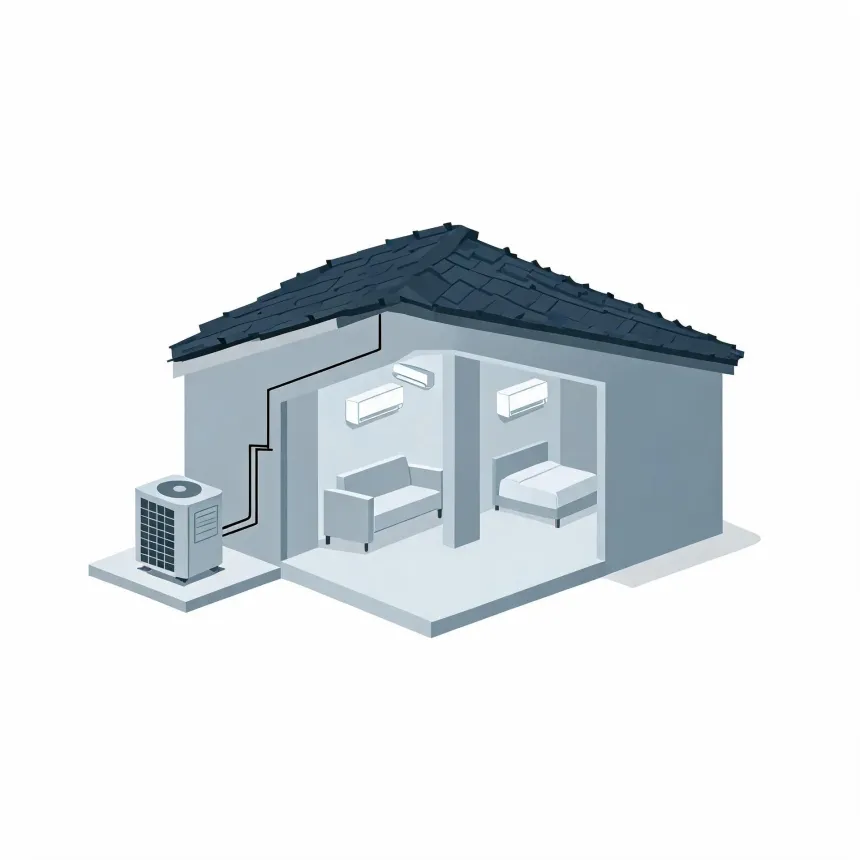
The outdoor condenser needs clear airflow and a path back to each indoor head through wall or floor. A straight shot through one exterior wall is a simple install. Running line sets up through a second floor or around the house to reach a far room takes more material and more labor.

6 months
November through April, your system heats
5 months
May through September, it cools
31°F
the average winter night it heats against
91°F
the average summer afternoon it cools against
Isometric illustration of a cutaway single-story house with a dark shingled roof, showing three wall-mounted indoor air conditioning units in two rooms connected by lines to an outdoor condenser unit on a pad outside.
Your system heats November through April and cools May through September.

NOAA nClimDiv, 1991–2020 normals

Cooling runs May through September here.

Get the mini split installed in April and it's running before that first hot week, not scrambling to catch up.

Electricity here runs 12.32 cents a kWh, so pick the system that holds up, not just the one with the best efficiency number

Power costs 12.32 cents a kWh statewide
Cooling runs May through September
Summer afternoons average 91°F
Built for homes already wired for electric heatElectricity heats 52.4% of homes in Sebastian County, a mini split fits right in

A mini split here runs cooling May through September, with afternoon highs averaging 91°F through the summer. That is steady, heavy load on the compressor for most of the warm season, not just a handful of hot days. Fort Smith also deals with damaging wind and hail on a regular basis, the kind of weather that tests an outdoor unit sitting exposed to it. A system sized too small will run flat out trying to keep the house comfortable and wear sooner than it should. Getting the outdoor unit and the heads sized right for the space matters more here than picking the lowest bid.

Any mini split installed here has to clear 14.3 SEER2 and 7.5 HSPF2

Sebastian County falls in zone 3A. Under the federal standard, a ductless mini split counts as a split system, so it has to hit 14.3 SEER2 for cooling and 7.5 HSPF2 for heating. That rules out older, lower-rated equipment. A federal tax credit is available on qualifying systems, which helps offset a unit built to meet it.

Find a contractor
A man in a dark T-shirt and olive pants, seen from behind, carries a canvas tool bag up wooden porch steps toward a pale green front door beside a potted plant.
A white outdoor air conditioner condenser unit mounted on metal wall brackets against gray horizontal siding, with a blue sky and white clouds behind it.

Five months of steady load, every year

Five months of cooling, and the compressor is working the whole stretch, not just on the hottest days. That is the load to size for. A contractor should run a load calculation on this house, not just match the size of whatever is being replaced, since the old system may have been wrong for the space to begin with. Ask what SEER2 and HSPF2 numbers the quote is built around, and what size compressor they landed on and why.

Bigger isn't better here

An oversized mini split cools the room fast, shuts off, then starts again soon after. That on off cycling is what leaves a room clammy even though the thermostat says it hit temperature, because the unit never runs long enough to pull moisture out of the air. Too small and it just runs constantly, straining to reach a setpoint it can't hold on the hottest afternoons.

The load calculation, not the square footage

Sizing comes from a room by room load calculation, not a chart matching square footage to tonnage. It weighs window area and which way they face, ceiling height, how much insulation is in the walls and attic, and how many exterior walls each room has. Rooms that look the same size on paper can need different size heads once that's worked out.

SEER2 and HSPF2 are both ratios, cooling or heating output against the electricity it takes to produce it. A higher number means the compressor is getting more out of every cycle, not that the unit is bigger or stronger. One system can cool a room using less power than another and still land on the same temperature. That rating comes out of a lab test under set conditions, so it tells you how the equipment performs on average, not what it does on the afternoon the compressor is working hardest. A unit with a strong rating still needs to be sized for the room, matched to the right head, and installed with a clean line set run. Skip any of that and the number on the label stops meaning much.

The indoor heads go up first, mounted high on a wall or ceiling where the air can spread across the room. Each one connects to the outdoor unit through a small hole drilled for the line set, the refrigerant lines, power wire and condensate drain bundled together. That line set gets brazed, not just screwed together, and then the whole system is pulled down to a vacuum to clear out air and moisture before refrigerant ever moves through it. Skip that step and moisture sits in the lines, and the compressor wears against it for the life of the system. Once it holds vacuum, the lines get charged, the outdoor unit gets set on a pad or bracket with room for air to move around it, and each zone gets tested on its own thermostat before anyone calls it done.