




A row of single-story houses, one brick and others with pale siding and covered porches, behind a trimmed hedge and lawn, under large oak trees draped with Spanish moss.

Mini Split Installation in Fayetteville, AR

Tell us about the job

Takes about a minute. No obligation.

New system or replacementMini-splitWashington County, AR
Step 1 of 2

What ZIP code is the job in?

Washington County gets hit with rough weather often, 250 severe weather events between 2015 and 2024, hail and damaging wind among the most common. The outdoor unit on a mini split sits outside year round, so where it gets mounted and what's upwind of it matters here. Power is the other piece. A mini split runs on electricity the same as any heat pump, and a lot of Arkansas households lost power for a day or more last year. If backup power is something you're considering, this install is the time to ask about it.

7 months
October through April, your system heats
4 months
June through September, it cools
29°F
the average winter night it heats against
87°F
the average summer afternoon it cools against
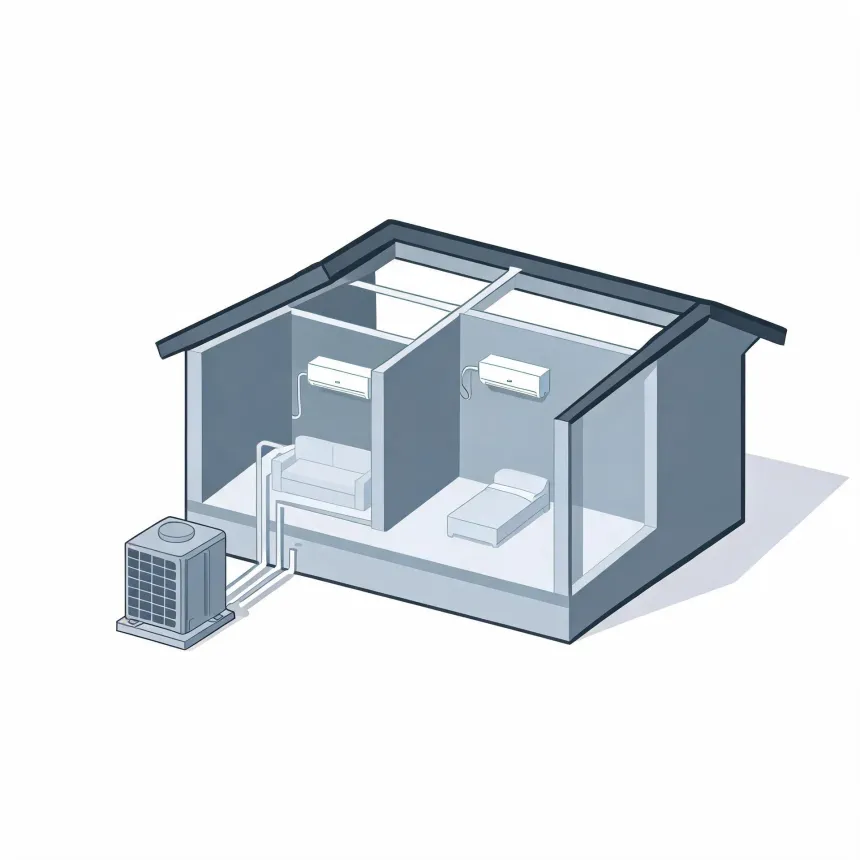
Illustrated cutaway of a two-room house showing two wall-mounted indoor air conditioning units connected by pipes to an outdoor condenser unit on the ground outside.
Your system heats October through April and cools June through September.

NOAA nClimDiv, 1991–2020 normals

Arkansas electricity ran 12.32 cents per kilowatthour in 2024, cheaper than most of the country.

A mini split here earns its keep on comfort and reliability, not on shaving a power bill that's already low.

Almost half of Fayetteville homes already heat with electricity

47.8% of homes heat with electricity
Cooling runs June through September
Summer afternoons average 87°F

Cooling runs June through September here, so May is the month to get a mini split in before the heat starts. Install it in May and the outdoor unit is already in place and running when the first hot days hit, instead of catching up after the fact. There's no rush that week either. An installer can take the time to size the system to the space and mount the outdoor unit where it'll hold up, rather than wherever's quickest. Wait until June and you're scheduling around everyone else who waited too.

Any mini split installed here has to meet the federal minimum, and a tax credit is on the table

A mini split installed here has to clear 14.3 SEER2 for cooling and 7.5 HSPF2 for heating, the federal minimum for split-system heat pumps built from 2023 on. That's the floor, not a menu of options to weigh against cheaper ones. A federal tax credit is available toward the cost of a qualifying system.

Find a contractor
A man in a dark shirt and tan work pants, seen from behind, carries a canvas tool bag up wooden porch steps toward a green front door of a shingled house with a potted shrub beside it.
A beige split-system air conditioner outdoor condenser unit mounted on metal wall brackets atop a stucco wall.

Four months of cooling, a full year of heating

Four months of cooling a year, June through September, with afternoon highs averaging 87 in the thick of summer. That's a real cooling load but not a heavy one next to hotter parts of the country, and the winter side matters here too, since Washington County sits in a mixed climate zone that asks real work of both. A standard mini split sized to the room handles both ends fine. Running four months isn't nothing, but it doesn't call for a bigger unit or a higher-tier system than the space needs. Size it to the room, not to the worst day of the year.

Bigger isn't better here

An oversized mini split cools the room down fast, shuts off, then starts again a few minutes later. That short cycling keeps the room from ever settling at an even temperature. It also keeps humidity high, because the unit never runs long enough to pull real moisture out of the air. A unit sized right runs longer, steadier stretches and leaves the room feeling even, not clammy.
The math behind the number

Sizing comes from a load calculation, not a square footage chart taped to the wall. The installer walks the room and counts what actually drives heat gain and loss. Window area and direction matter. So does insulation, ceiling height, and what's on the other side of each wall. Rooms that look the same size on paper can need different units once that work is done. A guess based on floor space alone gets it wrong as often as it gets it right.

Taking out the old system is part of the job, not an afterthought tacked onto the quote. If a window unit or wall unit is coming out, that opening needs to be closed up properly, not just covered over, or it becomes a draft and a leak point for years. If this is replacing ducted central air, the old condenser and line set get disconnected and hauled off, and the refrigerant in that old system has to be recovered, not vented, by law. None of that touches the new mini split's performance, but skipping it leaves you with a hole in the wall or a dead unit sitting in the yard. Ask what happens to the old equipment before the work starts, not after.

Installation day starts with the walk-through, confirming where the indoor head and outdoor unit are going before anyone picks up a tool. Mounting the indoor unit comes next, high on the wall where air can move across the whole room, then the installer drills through for the line set, a small hole that carries refrigerant lines, a drain line, and wiring together in one bundle. The outdoor unit gets set on a pad or bracket, the lines get connected and sealed, and then the system gets evacuated with a vacuum pump before any refrigerant moves. That step matters more than it looks. Any moisture or air left in the lines will sit there and cause problems down the road, so the installer pulls a vacuum and holds it to prove the lines are sealed before charging the system. Once that checks out, the unit gets powered on, tested for airflow and temperature at the head, and walked through with you before anyone packs up.