A lit antebellum-style two-story house with white columns and a wraparound porch at night, framed by live oak trees draped in Spanish moss.

Mini Split Installation in El Dorado, AR

Tell us about the job

Takes about a minute. No obligation.

New system or replacementMini-splitUnion County, AR
Step 1 of 2

What ZIP code is the job in?

Most homes here run on electricity

Electricity heats 53.6% of the homes in Union County, more than gas and propane combined. A mini split is an electric system, so it fits into a home already wired and billed for electric heat without adding a second fuel to the house.

Gas is still common enough to compare against

Utility gas heats 40.8% of homes in the county. If your furnace runs on gas, swapping to a mini split means heating the house on electricity instead, which changes what runs during a storm and what you're watching on the meter.

5 months
November through March, your system heats
5 months
May through September, it cools
35°F
the average winter night it heats against
92°F
the average summer afternoon it cools against
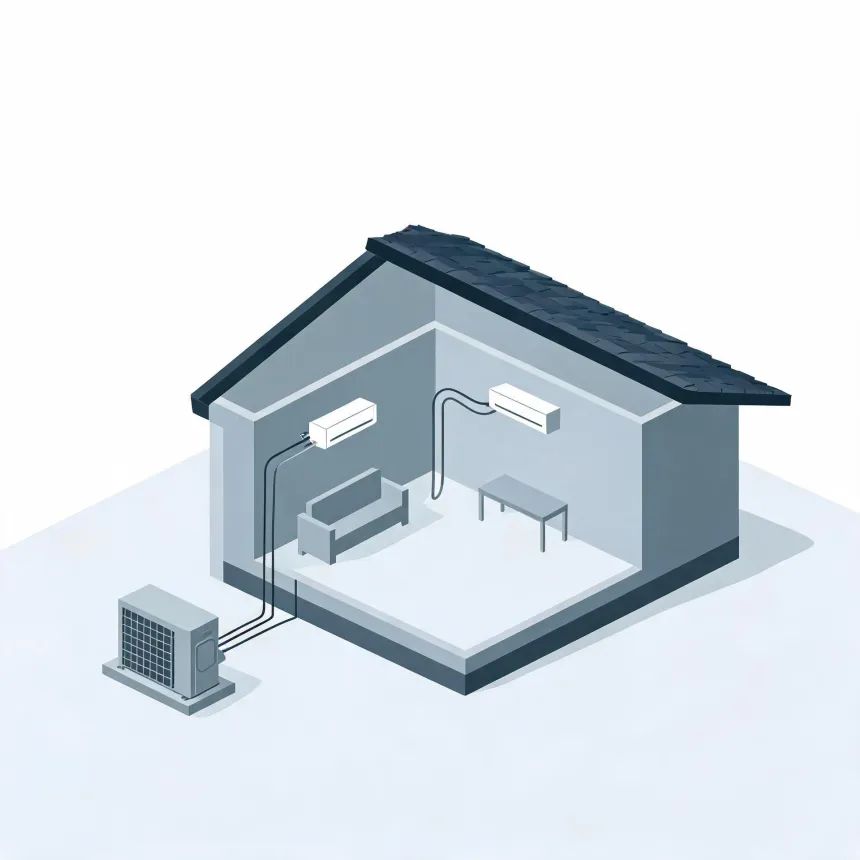
Isometric illustration of a cutaway house showing two wall-mounted indoor air conditioning units connected by line sets to an outdoor condenser unit, with a sofa and table inside the room.
Your system heats November through March and cools May through September.

NOAA nClimDiv, 1991–2020 normals

A mini split sized for this house costs 12.32 cents per kilowatt-hour to run here.

There's no local reason to size up or chase a higher efficiency tier than the house actually needs.

Get a mini split in before May, while it's still a quiet job instead of an emergency one

Cooling runs May through September
Summer afternoons average 92°F
Power costs 12.32 cents a kWh statewide

A mini split installed here runs cooling five months straight, May through September. Afternoon highs average 92°F across June, July and August, so the unit isn't cycling on a hot afternoon here and there, it's holding that line for weeks at a stretch. That's steady load on the compressor all summer. Sizing it right for the house matters more here than in a place where the system gets occasional relief. A unit sized too small will run flat out trying to catch up on the worst afternoons, and one sized wrong in the other direction wastes money without cooling the house any better.

A standard mini split, sized right, is all this house needs

Half the homes in Union County were built in 1979 or earlier, half in 1979 or later. That mix doesn't call for a bigger unit or a higher efficiency tier, just one sized to the house it's going into. Get that sizing done now and installation is a scheduled job, not a scramble when the next outage or heat spell hits.

Find a contractor
A beige split-system air conditioner outdoor condenser unit mounted on metal wall brackets atop a stucco wall.

Five months a year of this, every year

Five months of that load adds up on a compressor. The parts most likely to show it first are the capacitor and the contactor, and both are quick to check during a yearly tune-up. Get the sizing right at install, then ask whoever installs it what that yearly check should cover before the next May comes around.

Removing the old system is part of the job

A furnace, a window unit, old ductwork. Whoever installs the mini split has to take out what's there and haul it away. A gas line that fed the furnace gets capped off and left safe even though nothing runs on it anymore.

Old ductwork doesn't carry over

A mini split runs on refrigerant lines, not a duct run. If the house has ductwork built for a furnace, that ductwork doesn't connect to the new system. It can stay in place or come out, but either way it isn't doing any work once the mini split goes in.

What drives the price on a mini split job is mostly what you can't see from the brochure. How many indoor heads the house needs is the first thing, since a single room cooled by one unit is a different job from several rooms each getting their own. Where the outdoor compressor can sit matters too, and how far the line set has to run to reach each indoor head. A straight run through an open wall goes fast. A run that has to snake through an attic or around framing takes longer, and that time shows up in the labor, not the equipment. The electrical panel plays into it as well. Some panels have room for the new circuit a mini split needs. Others need work first before the system can be wired in at all. If an old furnace or window unit is coming out ahead of the install, that removal is its own piece of the job, separate from hanging the new one. None of this is on the unit's price tag. It's all in what it takes to put it in this house.

Install day starts with the outdoor compressor and the indoor heads going up, not the power getting turned on. The mounting plate for each indoor head goes against the wall first, then the line set runs from there to wherever the outdoor unit sits. That line carries refrigerant, so once it's connected the whole system gets evacuated of air and moisture before any refrigerant is allowed into it. Skip that step and the compressor is working against moisture for years, so it's not something a tech rushes. After that comes the electrical, running a dedicated circuit to the outdoor unit and tying in the indoor heads. Only once all of it is sealed, wired and tested does the system actually get charged and switched on, and that's when you find out if every head is cooling or heating the way it should.