A dark, minimalist bedroom featuring a sleeping cat on a grey-quilted bed, a wall-mounted air-conditioning unit, warm cove ceiling lighting, and a pendant lamp illuminating the bedside table.

Mini Split Installation in Conway, AR

Tell us about the job

Takes about a minute. No obligation.

New system or replacementMini-splitFaulkner County, AR
Step 1 of 2

What ZIP code is the job in?

Weather here is hard on outdoor equipment

Faulkner County recorded 174 severe weather events between 2015 and 2024, with damaging wind and hail among the most common. The outdoor unit sits through all of it, so where it's mounted and what shields it from wind and hail is worth deciding at install, not after.

Power doesn't always hold through a storm

Close to a quarter of Arkansas households lost power for 24 hours or more in 2024. If this mini split will carry your heat or hot water, it's worth planning for what happens to both when the power goes out.

6 months
November through April, your system heats
5 months
May through September, it cools
32°F
the average winter night it heats against
91°F
the average summer afternoon it cools against
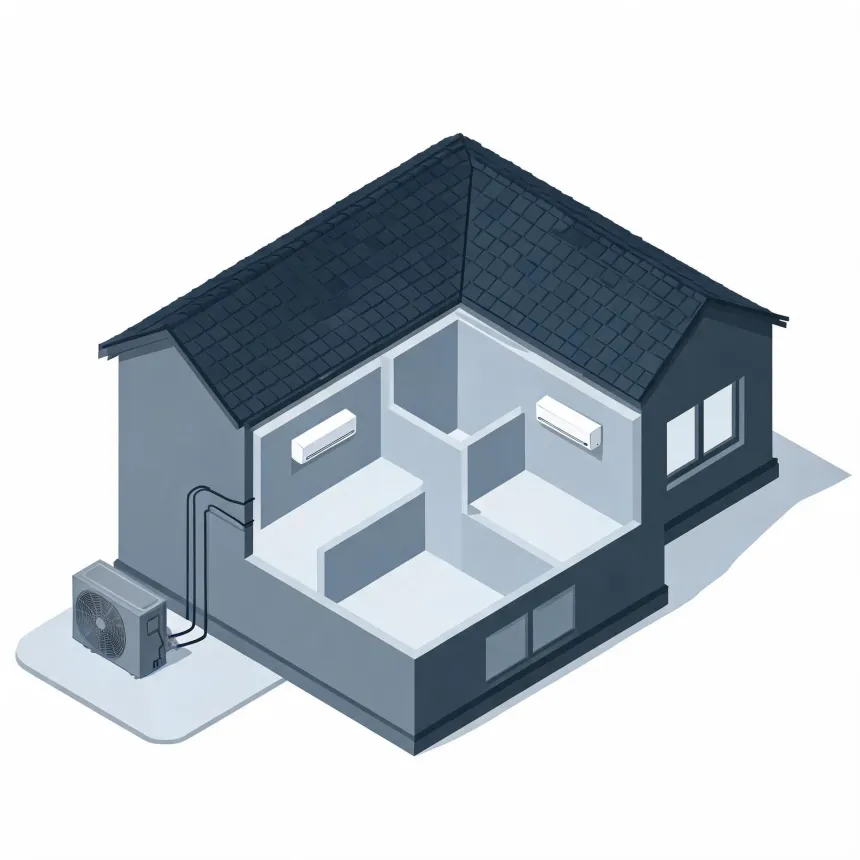
Isometric illustration of a cutaway single-story house with a dark shingled roof, showing two wall-mounted indoor air conditioning units connected by lines to an outdoor condenser unit on a pad beside the building.
Your system heats November through April and cools May through September.

NOAA nClimDiv, 1991–2020 normals

A mini split here doesn't need to be oversized or top of the line to do the job.

Arkansas electricity runs 12.32 cents a kilowatt-hour, so a correctly sized standard unit is what keeps that bill reasonable.

Most homes in Faulkner County already heat with electricity

65.8% of homes heat with electricity
Cooling runs May through September
Summer afternoons average 91°F

Cooling runs May through September here, about five months straight. April is when to get a mini split installed, not May. Once the heat sets in, any install gets harder to schedule and the old system still has to carry you while you wait. Doing it in April means the new system is tested and running before it has to work for a single day.

Five months of 91 degree afternoons. Size it for that.

Summers here mean five months of cooling, with afternoons averaging 91°F in June, July and August. That's steady work for a mini split, running day after day through the heat. Getting the size right matters more than any brand name on the unit, so make sure the load calculation is done for this house.

Find a contractor
A white outdoor air conditioner condenser unit mounted on metal wall brackets against gray horizontal siding, with a blue sky and white clouds behind it.

Five months a year of carrying the load

Five months of summer, every year, and the compressor is what carries that load. It cycles on and off all day long to hold the house at temperature, and a unit sized too big for the space short cycles instead, shutting off before it pulls the moisture out of the air. Ask the installer for the load calculation itself, not just the number they landed on, so you can see the window sizes and square footage they used.

How many zones you're running

A single indoor head costs less to install than a system feeding several rooms off one outdoor unit. Each additional zone means another line set, another mounting point, and more labor to route refrigerant lines through walls or attic space. More zones also means more decisions about where each head goes and how the outdoor unit is sized to carry all of them at once.

What it takes to get refrigerant lines where they need to go

The outdoor unit and each indoor head connect through a line set that has to run through a wall, down a chase, or across an attic. A straight shot through one exterior wall is the simplest path. Longer runs, runs through finished space, or a line set that has to clear framing or existing ductwork all add labor before the system ever gets charged and tested.

Taking out the old system is its own job, separate from hanging the new one. If the house is leaving window units or a central air system behind, those get disconnected and hauled off, and any refrigerant left in the lines gets recovered rather than vented. A central system also leaves behind ductwork, and that duct work either gets capped off or tied into the new setup depending on how the mini split is configured. None of this is difficult work, but it's work that has to happen before the new lines get run, so it belongs in the schedule and the quote from the start.

Install day starts with the outdoor unit, since where it sits decides where everything else can go. The installer mounts it on a pad or brackets, then moves to the wall position for each indoor head. A small hole gets drilled through the wall for the line set, the power cable and the condensate drain, all bundled together and run to the outdoor unit. Once the lines are connected at both ends, the system gets evacuated with a vacuum pump to pull out moisture and air, because any left behind turns to acid or ice once refrigerant is running through the lines. Only after it holds a vacuum does the installer open the valves and let refrigerant into the system. The last step is running it, checking the temperature split at each head and the pressures at the outdoor unit, before anyone calls the job done.