A white Southern-style house with a wraparound porch photographed at night, surrounded by Spanish moss-draped oak trees lit by landscape lights.

Mini Split Installation in Camden, AR

Tell us about the job

Takes about a minute. No obligation.

New system or replacementMini-splitOuachita County, AR
Step 1 of 2

What ZIP code is the job in?

Gas heats most homes here

Utility gas heats 48.7% of occupied homes in Ouachita County. Electricity is next at 40.5%, with LP gas making up the rest. A mini split installed here is usually going in alongside a gas furnace, not replacing the main heat source.

What that means for the job

If gas already handles the cold months, a mini split's job is often to cover a room the furnace doesn't reach well, or to take over cooling and light heating in spring and fall. The contractor sizing the system needs to know what it's actually replacing or supplementing before picking a unit.

5 months
November through March, your system heats
5 months
May through September, it cools
34°F
the average winter night it heats against
91°F
the average summer afternoon it cools against
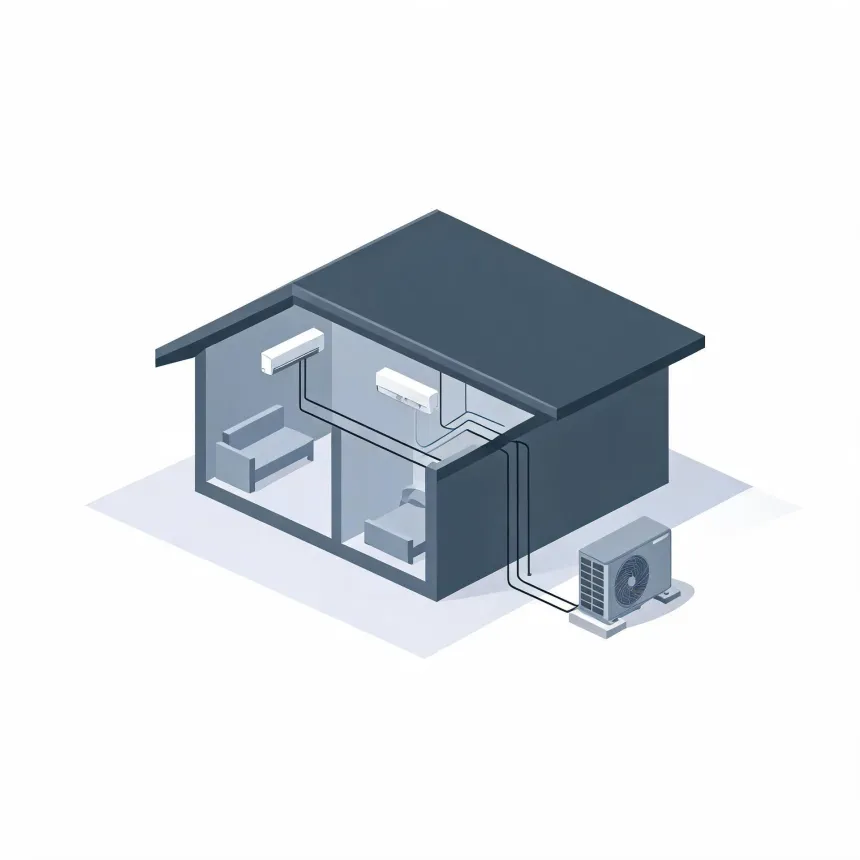
Isometric illustration of a cutaway house showing two wall-mounted mini-split indoor units connected by line sets to an outdoor condenser on a pad outside.
Your system heats November through March and cools May through September.

NOAA nClimDiv, 1991–2020 normals

Half the homes in Ouachita County were built in 1974 or earlier, half later.

A mini split sized for the room it's heating or cooling doesn't care which year the house went up.

Five months of 91 degree afternoons, every year

Cooling runs May through September
Summer afternoons average 91°F
Power costs 12.32 cents a kWh statewide

A mini split doesn't need to be sized around storms or power outages. Ouachita County recorded 62 severe weather events between 2015 and 2024, most of them wind and hail, and none of that changes what size unit a given room needs. Sizing comes down to the square footage, the windows, and how the room is used. A standard mini split, installed and charged correctly, heats and cools the way it's rated to regardless of what the weather does outside. The one thing worth asking the contractor is what happens to the unit if the power goes out and comes back, since most start back up on their own without anyone resetting anything.

Installed before May, running on your schedule

Cooling here starts in May and runs through September. Put a mini split in during April and it's charged, tested, and working before the first hot day asks anything of it. Wait until the heat is already on and the job competes with every other homeowner having the same problem at the same time.

Find a contractor
A white mini-split air conditioner outdoor condenser unit mounted on metal brackets against a beige stucco exterior wall, with a blue sky and scattered clouds in the background.

It runs for years, so ask what it's rated for, not what it's priced at

When comparing systems, ask what each one is rated to do at the outside temperature you'll actually run it in, not just the number on the brochure. A compressor loses capacity as the air gets colder or hotter, and units that look alike on paper can behave differently once they're working hard. Ask how the outdoor unit and the indoor head were matched to each other. A head that's oversized for its compressor will short cycle, switching off before it pulls moisture out of the room or settles into a steady temperature. One that's undersized will run constantly and still not keep up. Ask about the line set, how long the run is and how many bends it needs, since that changes how the system performs even when the equipment itself is identical. And ask what the warranty covers if someone other than the installing contractor ends up servicing it later, because coverage can depend on who did the original work.

The outdoor unit and the line set drive the cost

A mini split's price moves with how far the outdoor unit sits from the indoor head and what's between them. A short, straight run through an easy wall costs less than one that has to climb, turn corners, or cross framing to reach where the compressor can sit. Multiple indoor heads off one outdoor unit add cost for each head, and each one still needs its own line set run.

Where the head goes changes the work

Mounting an indoor head on an exterior wall is usually simpler than running lines through an interior wall to reach a room on the far side of the house. The electrical work matters too. A mini split needs its own dedicated circuit, and whether the panel already has room for it or needs new breaker space changes what the installer has to do before the unit ever gets hung.

The efficiency rating on a mini split, the SEER2 and HSPF2 numbers on the yellow label, tells you how much heating or cooling the unit produces for the electricity it uses. A higher number means more output per unit of power, not a bigger or stronger unit. Mini splits can heat the same room to the same temperature and use different amounts of electricity doing it, and the rating is how you tell them apart before either one is running. That rating comes from a lab test under set conditions, so it describes the equipment, not what a given room will see once walls, sun, and how the space gets used are part of the picture. It's also a matched-system number. The outdoor compressor and the indoor head were tested together to earn it, so putting a different head on that compressor later can change what the system actually delivers, even if the rating printed on the outdoor unit never changes.

Install day starts with the walls, not the equipment. The indoor head needs a clear run to the outdoor unit, so the first real work is deciding where the line set, the drain line, and the electrical whip will travel, then cutting a hole through the wall for them to pass through together. That hole gets sealed once everything is routed, so it's weather tight on both sides. The outdoor unit gets mounted on a pad or brackets, leveled, and set with clearance around it so air can move through the coil. Once the indoor and outdoor units are connected, the line set gets evacuated with a vacuum pump to pull out air and moisture before any refrigerant goes in, because trapped moisture left in the line causes problems later that are hard to trace back to the install. Only after that does the system get charged, and the contractor should test it running in both heating and cooling before calling the job done.