A red brick wall with a row of low shrubs and mulch bed on the left, a mown lawn in the center, and a single-story light-colored house with a gabled roof beyond, backed by pine trees under an overcast sky.

Mini Split Installation in Booneville, AR

Tell us about the job

Takes about a minute. No obligation.

New system or replacementMini-splitLogan County, AR
Step 1 of 2

What ZIP code is the job in?

Most homes here run on electric heat

Electricity heats 59.3% of homes in Logan County, more than any other fuel. Gas serves about a third of homes, and LP gas a small share beyond that. A mini split fits an electric home without the extra step of tying into gas lines or venting.

What that means for a mini split install

In a home already set up for electric heat, a mini split takes over the job a baseboard heater or electric furnace was doing, using less power to do it. There's no fuel conversion to plan around, just where the outdoor unit and line set will go.

7 months
October through April, your system heats
5 months
May through September, it cools
31°F
the average winter night it heats against
90°F
the average summer afternoon it cools against
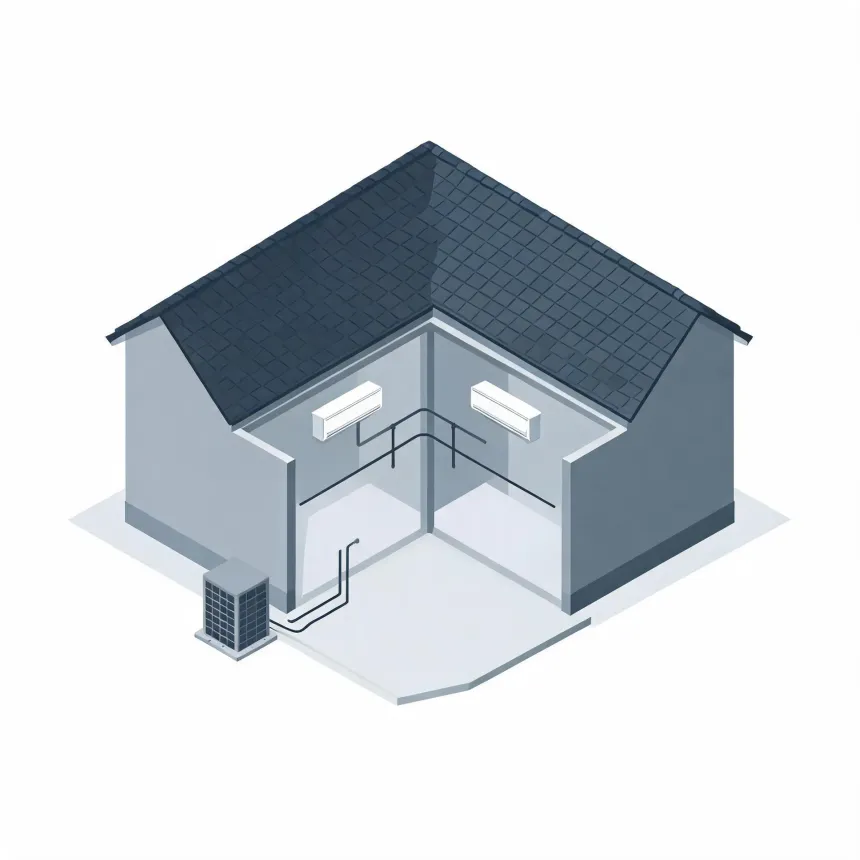
Isometric illustration of a cutaway gray house with a dark shingled roof, showing two wall-mounted indoor air conditioning units connected by piping to an outdoor condenser unit on the ground outside.
Your system heats October through April and cools May through September.

NOAA nClimDiv, 1991–2020 normals

Every quote should list the condenser size and the indoor head size separately.

A mismatched pair cools the room but never reaches the efficiency or comfort the system was rated for.

Five months of 90 degree afternoons is a full season of work for one system

Cooling runs May through September
Summer afternoons average 90°F
Power costs 12.32 cents a kWh statewide
Booneville runs on cheap powerArkansas electricity averaged 12.32 cents per kilowatthour in 2024, so a mini split earns its keep on comfort more than on the bill.

Cooling runs May through September here, five months of steady work for a mini split. April is the window to get one installed, before that first run of warm days starts. Order it now and the outdoor unit and line set go in on a normal schedule, with time to test the system before it has to carry the season. Wait and you're asking for the same install after cooling has already started, on whatever timeline a contractor has open at that point. A mini split put in under pressure still gets sized and set up right, but there's no reason to make April's job a May scramble.

A new system here has to meet zone 3A's minimum

Logan County sits in climate zone 3A. Any mini split installed here has to meet the federal minimum for a split-system heat pump. That means 14.3 SEER2 for cooling and 7.5 HSPF2 for heating. A federal tax credit is available for qualifying systems, on top of meeting that floor.

Find a contractor
A man in a cap, dark long-sleeve shirt and tan work pants carries a leather tool bag up porch steps toward a green front door, with a potted flowering plant beside him.
A white mini-split air conditioner outdoor condenser unit mounted on metal brackets against a beige stucco exterior wall, with a blue sky and scattered clouds in the background.

Five months of work a year, so size it for the load

Five months of afternoons near 90 degrees means the compressor is cycling on and working to pull heat out of the house most of that time, not just on the hottest days. A unit sized too small for the space will run close to flat out through all of it. Get a load calculation done for the house, not a guess based on square footage, and size the condenser to match. The install itself should include enough refrigerant line and a condenser pad placed where summer sun and heat off the house won't make the unit work harder than it has to.

The number of zones sets the cost

A single indoor head paired with one outdoor condenser is the simplest install. Add a second or third zone and the outdoor unit has to be a multi-zone model built to run several heads at once, with its own line set and power run to each room. More zones means more labor, more refrigerant line, and a bigger outdoor unit to feed them all.

Where the line set has to travel matters

The cost isn't just the equipment. It's how far the refrigerant line has to run from the outdoor condenser to each indoor head, and what it has to pass through to get there. A line set that runs through an exterior wall and straight to the head costs less to install than one that has to be routed through an attic, down an interior wall, or around framing to reach a room on the far side of the house.

If this is replacing an old system, whoever installs the mini split has to deal with what's already there. A window unit or electric baseboard just gets disconnected and hauled off, nothing to it. A central system is more involved. The old condenser outside gets disconnected and removed, and if the ductwork isn't being reused for anything, it's usually left in place rather than torn out, since pulling it out of walls and ceilings is its own job. Any refrigerant left in the old lines has to be recovered, not vented, that's a legal requirement, not a courtesy. If the old system ran on gas, the gas line serving it gets capped off by whoever is licensed to do that. None of this adds much time to the install itself, but it's worth asking what the contractor plans to do with the old equipment before the work starts, not after.

Install day starts with the outdoor condenser going on its pad or wall bracket, then the line set getting run to wherever each indoor head is going. That line set gets cut to length and connected, and then the whole system gets evacuated with a vacuum pump before any refrigerant moves through it. That step matters more than it looks. Any moisture or air left in the lines causes problems later, so a contractor who skips the vacuum and just charges the system is cutting a corner that shows up down the road. Once the lines hold vacuum, the system gets charged, the indoor heads get mounted and leveled, and the electrical connections get made at both ends. Before anyone leaves, the system should run in both cooling and heating so each head gets checked, not just the outdoor unit.