A nighttime street scene featuring a row of lit white colonial-style houses with wrap-around porches, flanked by oak trees draped in Spanish moss.

Mini Split Installation in Blytheville, AR

Tell us about the job

Takes about a minute. No obligation.

New system or replacementMini-splitMississippi County, AR
Step 1 of 2

What ZIP code is the job in?

Weather here is hard on outdoor equipment

Mississippi County logged 126 severe weather events between 2015 and 2024, with wind and hail among the most common. A mini split's outdoor unit sits outside year round, so where it's mounted and what's around it matters more here than in calmer places.

Outages are common enough to plan for

Nearly a quarter of Arkansas households lost power for 24 hours or more in 2024. A mini split runs on electricity, so a storm that cuts power takes your heat or cooling with it. Worth asking your installer about backup options before the system goes in, not after the next outage.

7 months
October through April, your system heats
5 months
May through September, it cools
33°F
the average winter night it heats against
89°F
the average summer afternoon it cools against
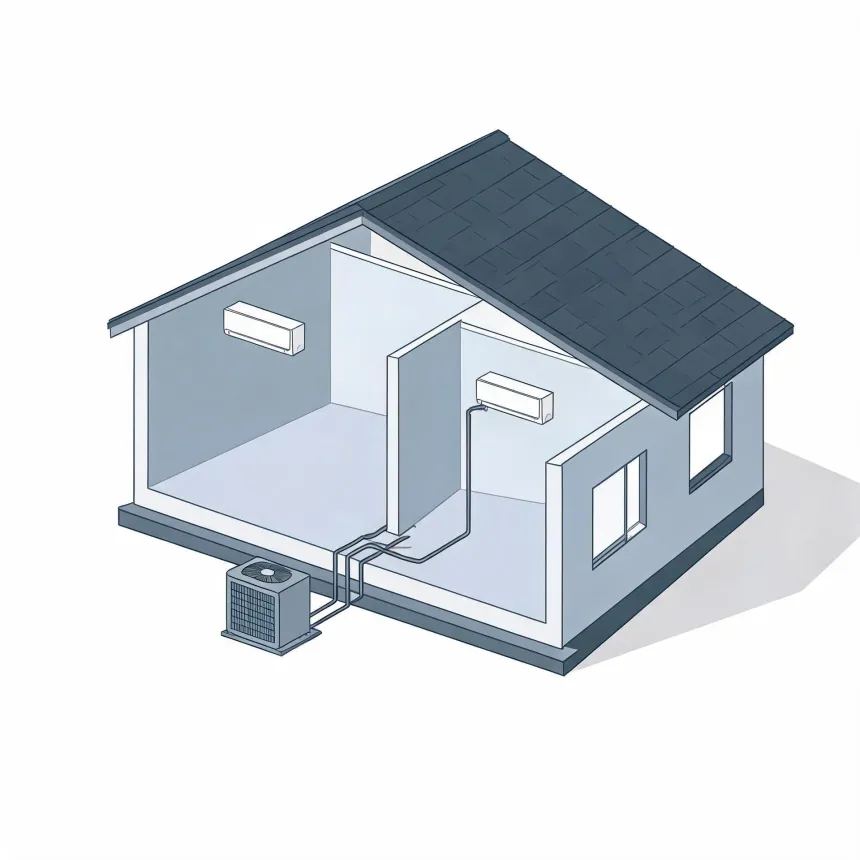
Isometric cutaway illustration of a small house with a dark shingled roof, showing two wall-mounted indoor units connected by lines running to an outdoor condenser unit beside the building.
Your system heats October through April and cools May through September.

NOAA nClimDiv, 1991–2020 normals

A mini split sized right for Blytheville runs on standard efficiency ratings, nothing special ordered in.

At 12.32 cents per kilowatt-hour, a correctly sized unit keeps your bills in line without paying extra for capacity you don't need.

Five months of cooling, summer afternoons near 89, every year

Cooling runs May through September
Summer afternoons average 89°F
Power costs 12.32 cents a kWh statewide

Gas heats half the homes in Mississippi County, electricity heats most of the rest. A mini split doesn't replace either one outright. It's a separate system, usually brought in to cover a room or an addition the furnace and ducts don't reach well, or to handle cooling in a house that never had central air. If gas heat already runs the rest of your house, the mini split can take over just the space it's installed in and leave the furnace doing what it does. That's the usual setup here, and it's worth telling your installer upfront what the rest of the house already runs on.

Install before May, so it's running before the heat is

Cooling starts in May here and runs five months straight. Put a mini split in during April and it's ready on day one, with no rush job during the first hot week and no run-in period competing with a house that already needs cooling.

Find a contractor
A man in a dark cap, dark rolled-sleeve shirt and tan trousers walks up porch steps toward a pale green panelled door, carrying a worn canvas tool bag in his left hand, with a potted shrub beside the entry.
A white mini-split air conditioner outdoor condenser unit mounted on metal brackets against a beige stucco exterior wall, with a blue sky and scattered clouds in the background.

Years of running, not years of the house

Half the homes in Mississippi County were built in 1977 or earlier, half since then. That split doesn't point a mini split toward anything bigger or more complicated. Sizing still comes down to the room it's covering and the heat that room picks up during the day, not how old the house around it is. A correctly sized system here is a standard one, no special tier needed to handle this county.

How many rooms it covers

A single outdoor unit can run one indoor head or several. Each extra room or zone means another indoor unit, another line set, another spot on the wall to mount and run power to. A system covering one room costs less to put in than the same total cooling need split across several rooms.

What's between the outdoor unit and the walls

Refrigerant travels from the outdoor unit to each indoor head through a line set, and that line set has to pass through a wall somewhere. A straight path through one exterior wall is a simple job. A line set routed up through a second floor or around framing to reach a far room takes longer and costs more to do right.

Whatever is being replaced still has value in parts even when the whole system doesn't. A working compressor or a line set in good shape sometimes gets reused if the new install can make use of it, though most of the time it's simpler to pull it all and start clean. The old outdoor unit gets disconnected, the refrigerant recovered rather than vented, since it's not legal or safe to just let it out. Indoor heads come off the wall, and whatever line set ran through the wall gets capped or removed depending on whether it's being reused. None of this is work you do yourself. A licensed installer handles the teardown the same visit they do the new install, so you're not living with a dead unit on the wall while you wait on a second appointment.

Install day starts with the outdoor unit, mounted on brackets or a pad somewhere it has clearance on all sides to pull in air. From there a hole gets drilled through the exterior wall, just wide enough for the line set, the wiring, and the condensate drain to pass through together. The indoor head mounts on the wall first, then the installer runs the line set from indoor to outdoor and connects it. Once the lines are joined, the system gets evacuated with a vacuum pump to pull out air and moisture before any refrigerant goes in, since either one left in the lines causes problems later. Refrigerant gets charged to the line length, not just dumped in by a fixed amount. After that it's a power-on test, checking that the head blows cold or warm as it should and that the drain line is actually draining.