Most homes here run on electric heat
Electricity heats 50.8% of homes in Carroll County, more than gas or propane. A mini split fits into that picture without asking you to add a fuel line or rework how the house is set up.
Takes about a minute. No obligation.
Electricity heats 50.8% of homes in Carroll County, more than gas or propane. A mini split fits into that picture without asking you to add a fuel line or rework how the house is set up.
Utility gas heats 23.2% of homes here and propane heats another 17.2%. If your house runs on one of those, a mini split can work alongside the existing furnace or take over specific rooms instead of replacing the whole system.
NOAA nClimDiv, 1991–2020 normals
Carroll County has seen its share of damaging wind and winter storms over the past decade.
None of that changes what a mini split needs to do here. A standard unit, sized and installed correctly, holds up fine.



Cooling starts in June here, so May is the month to get a mini split installed. Do it before the first hot week and you get to pick the install date, not scramble for whoever answers the phone first. A mini split run from June through September needs the right size for the rooms it's covering and a clean line set installation, and that takes a little time to get right. Waiting until the heat is already on means a rushed job or a wait with no cooling while you're in line behind everyone else who waited too.
Carroll County falls in climate zone 4A, and any mini split installed here, ductless units included, has to meet the federal minimum of 14.3 SEER2 for cooling and 7.5 HSPF2 for heating. That rule narrows what a contractor can offer you. A system that meets it also qualifies for the federal energy efficiency tax credit.
Find a contractor
Whatever is heating and cooling those rooms now, a new mini split doesn't have to mean it comes out. A ducted furnace or central system can stay in place and keep doing what it does, with the mini split covering the rooms that need it most. If the old system is a window unit or electric baseboard, those typically just get switched off and left alone, or removed if they're in the way. The one thing worth checking before install day is whether an old wall unit or through-the-wall sleeve is sitting where the new line set needs to run, since that's the kind of thing that changes the job.
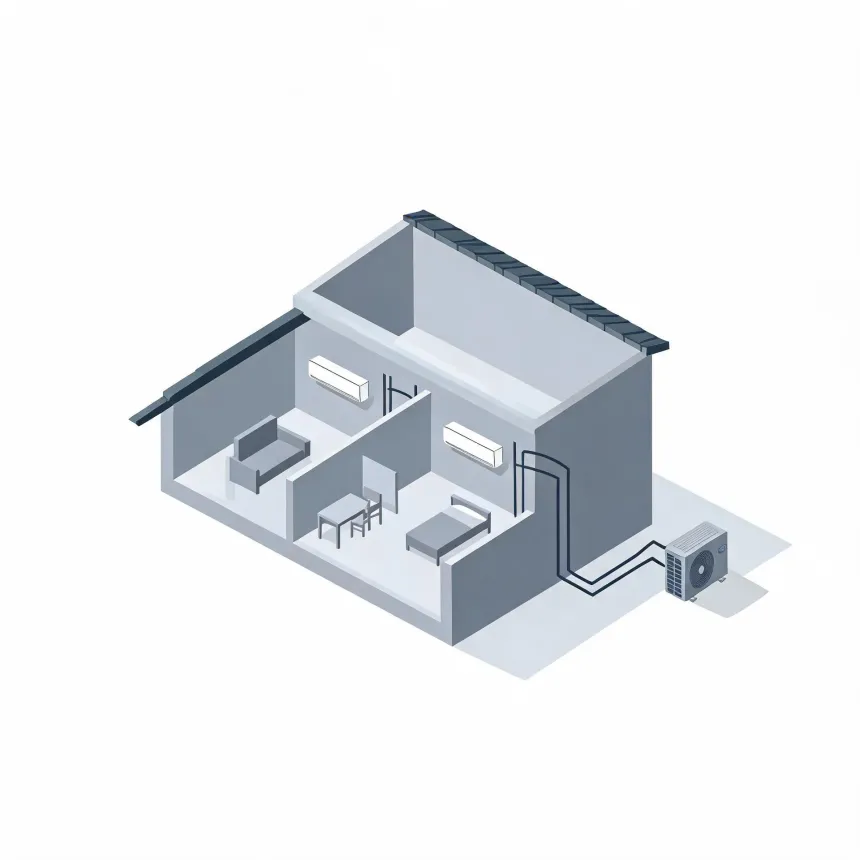
One outdoor condenser can feed several indoor heads, but each one it feeds splits the total capacity between them. If every room is supposed to hit the same comfort level on the coldest or hottest day, ask whether the outdoor unit was sized for that, or just for mild weather with everyone running at once.
The indoor and outdoor units connect through a line set that runs through the wall, and that path is set once and not easily moved. If a contractor is quiet on where that line runs or how the wall gets patched, ask directly. It's easier to fix on paper than after the hole is already cut.
What drives the cost on a mini split job is mostly labor, not the equipment sitting in the box. Running the line set is the biggest piece of that. A short, straight shot from outdoor unit to indoor head takes a lot less time than a run that has to go through an attic, drop down an exterior wall, or snake around framing to reach the room it's cooling. Every additional zone adds its own line set, its own mounting bracket, and its own share of the outdoor unit's capacity, so adding zones costs more than just the price of the extra head. Electrical work matters too. If the panel has room for a new dedicated circuit, that's a simple add. If it doesn't, upgrading the panel becomes its own job. Where the outdoor unit ends up, and how much pad or bracket work it takes to set it there, plays into it as well.
Sizing a mini split comes down to matching the indoor head to the heat gain and heat loss of the specific room it covers, not the square footage of the whole house. A contractor works that out with a load calculation that accounts for the room's windows, how many exterior walls it has, the ceiling height, and what's on the other side of those walls. Get it oversized and the unit short cycles, blasting cold air and shutting off before it pulls the humidity out, which leaves the room feeling clammy even at the right temperature. Get it undersized and it runs constantly, struggling to catch up on the hottest or coldest days and never quite getting there. Neither mistake shows up on day one. It shows up months in, in a room that never feels right no matter where the thermostat is set.