Two illuminated white colonial-style houses with wrap-around porches, flanked by oak trees draped in Spanish moss, photographed at night.

AC Installation in Trumann, AR

Tell us about the job

Takes about a minute. No obligation.

New system or replacementCentral ACPoinsett County, AR
Step 1 of 2

What ZIP code is the job in?

The Southeast rule sets the floor

Trumann falls under the Southeast's regional standard, not just the national one. Any split system under 45,000 Btu/h going in has to hit at least 14.3 SEER2. That's higher than what the rest of the country requires.

Old ratings don't qualify

A new AC installed here has to come built to clear that number already. Whoever installs your system is working from equipment manufactured to meet it, which rules out older, lower-rated units some suppliers still have on the shelf.

5 months
May through September, your air conditioner is on duty
90°F
the average summer afternoon it cools against
32 hail events
in ten years, and hail bends the fins on outdoor coils
13.4 SEER2
the federal minimum any new unit must meet
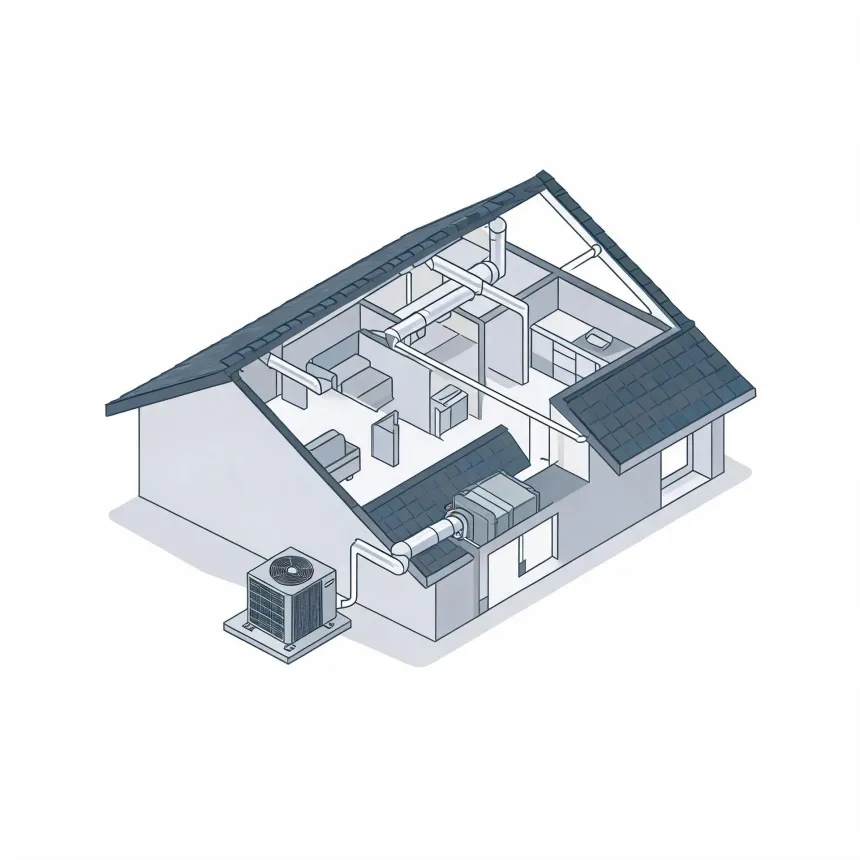
Isometric line illustration of a cutaway single-story house showing interior rooms, ceiling ductwork and an air handler, connected to an outdoor condenser unit on a pad beside the building.
Your air conditioner works hardest from June through September.

NOAA nClimDiv, 1991–2020 normals

Close to half the homes in Poinsett County heat with electricity.

If your system runs on electric heat already, replacing it with another electric system keeps the installation straightforward.

A standard system is the right call here

Half the homes here were built by 1978
Cooling runs May through September
Summer afternoons average 90°F

Once the new system is in, the old one comes out. The refrigerant gets recovered first, not vented, since it's against the law to release it into the air. After that the outdoor unit, the indoor coil and the old line set get disconnected and hauled off. If the furnace or air handler is being swapped too, that comes out the same way. Whoever installs your system should leave the space where the old equipment sat clean and ready, with nothing left hanging that used to connect to it.

The right system for this home is already decided

The size and efficiency that fits this home is already settled, so there's nothing left to weigh. Electricity here runs 12.32 cents per kilowatthour, and a standard system is built to run on that without any special sizing or upgrades.

Find a contractor
A man in a dark T-shirt and tan work pants, carrying a canvas tool bag, walks up wooden steps toward a green front door flanked by white siding and a potted shrub.
An outdoor residential air conditioning condenser unit mounted on a concrete pad, surrounded by gravel with a blue sky in the background.

Get it in before May

Cooling runs here from May through September, five months straight. That's five months of the compressor cycling on and off, all day and into the night. Installing before May means the system goes in on your timeline. Wait until it's already hot and you're choosing from whatever's in stock, on whatever day a crew is free.

Ask what the warranty actually covers

Most equipment warranties cover parts but not labor, and they usually require the system to be registered within a set window after install. Ask whether labor is included, for how long, and whether the warranty is void if someone other than the installing contractor ever works on the unit. Get the answer in writing, not just a verbal assurance.

Ask who pulls the permit

A permitted installation gets inspected by someone outside the company doing the work, which is a second set of eyes checking the refrigerant lines, the electrical disconnect, and the condensate drain. If a contractor suggests skipping the permit, that's a sign the work may not hold up to inspection, not a favor that saves you money.

Aerial view of a square outdoor air conditioning condenser unit on a concrete pad beside a house wall with a sliding glass door.

Going above the federal minimum saves little here, about $20 a year.

  • A higher-efficiency unit$310 a year
  • A new unit at the federal minimum, 14.3 SEER2$330 a year

Estimates for a typical Poinsett County home, from EIA household energy data, Arkansas fuel prices and NOAA climate normals. Your home will differ.

Installation day starts with the old equipment coming out and the new line set going in, so expect the system to be down for stretches of the day. The outdoor pad gets leveled or replaced if it's cracked or sinking, since the new unit needs to sit flat. Indoors, the coil goes in above or beside the furnace or air handler, and that's where most of the fitting and soldering happens. Once everything's connected, the line set gets pressure tested for leaks before any refrigerant goes in, and the system runs through a vacuum to pull out moisture and air. Only after that does the refrigerant charge go in, measured against the manufacturer's spec for that exact unit. Before the crew leaves, the system should run through a full cooling cycle so you can feel cold air at the vents and hear it cycle off on its own.