A white Southern-style house with a wraparound porch photographed at night, surrounded by Spanish moss-draped oak trees lit by landscape lights.

AC Installation in Cherokee Village, AR

Tell us about the job

Takes about a minute. No obligation.

New system or replacementCentral ACSharp County, AR
Step 1 of 2

What ZIP code is the job in?

Most homes here run on electricity

Electricity heats 53.9% of occupied homes in Sharp County, with another 32.0% on bottled or LP gas. Few homes have utility gas at all. That split points to heat pumps and electric furnaces paired with central air, since the ductwork and power setup for electric heat is usually already there.

What that means for your install

If your home already heats with electricity, a new AC or heat pump system can often use the existing ductwork and electrical setup rather than needing new gas lines run. Matching what the house already has keeps the job simpler and avoids work that a gas conversion would require.

5 months
May through September, your air conditioner is on duty
88°F
the average summer afternoon it cools against
20 hail events
in ten years, and hail bends the fins on outdoor coils
13.4 SEER2
the federal minimum any new unit must meet
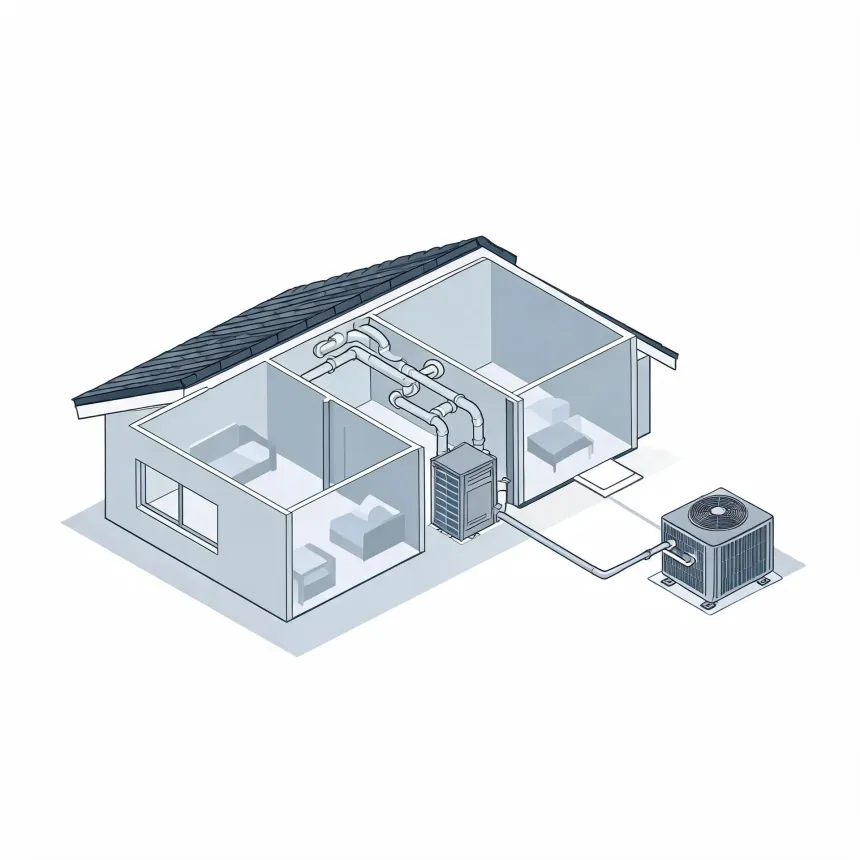
Isometric line illustration of a cutaway single-story house showing interior rooms, ductwork, an indoor air handler or furnace, and a refrigerant line running to an outdoor condenser unit on a pad.
Your air conditioner works hardest from June through August.

NOAA nClimDiv, 1991–2020 normals

The size on the nameplate of your old system is not proof of the right size for the new one.

A contractor should run a load calculation on the house itself before quoting a tonnage.

Power here runs 12.32 cents a kWh, so the cheapest system to run isn't always worth the extra cost to buy

Power costs 12.32 cents a kWh statewide
Cooling runs May through September
Summer afternoons average 88°F
A standard system fits this house fineHalf the homes in Sharp County were built in 1978 or earlier, half after. Neither age needs a bigger or pricier system than the other.

Cherokee Village runs its AC about five months a year, May through September, with afternoon highs around 88°F in June, July and August. That's an ordinary summer load. A central AC or heat pump sized to the house with a load calculation will keep up with it, no extra tonnage needed. There's nothing in this heat that calls for a bigger unit or a higher-efficiency model than the house actually needs. A standard system, installed correctly, handles it.

Your new AC has to meet a higher regional standard than most of the country

Any new split-system AC installed here has to meet 14.3 SEER2, the Southeast minimum for units under 45,000 Btu/h, not the lower 13.4 SEER2 standard that applies elsewhere in the country. That sets the floor before you even start comparing units. A federal tax credit is available on qualifying equipment, which can offset some of that baseline cost.

Find a contractor
A gray metal air conditioning condenser unit mounted on a concrete pad in a flat grassy field under a partly cloudy sky.

What actually moves the price

What you pay for an install comes down to what the installer has to do, not just the equipment sitting on the pad. A straight swap, same spot, same ductwork, same electrical, is the simplest version of this job. Add a line set that has to run further, a disconnect box that needs replacing, or ductwork that was never sized right for the house, and the labor climbs even though the unit itself didn't change. Where the air handler and condenser sit matters too. Tight attics, closets with no clearance, a condenser wedged against a wall, all of that slows a crew down. Electrical work is its own line item. Some panels can take a new system as is. Others need a breaker upgrade or new wiring run before the unit can be hooked up at all, and that's not something you can see from the nameplate on the old unit. Efficiency is a separate choice from sizing. A higher SEER2 unit costs more up front, and that cost buys lower running costs over the life of the system, not better cooling on a hot day. A correctly sized standard system and an oversized high-efficiency one will both cool the house. The oversized one just costs more to own.

Bigger doesn't mean better cooling

An oversized system cools the air fast and shuts off before it pulls the moisture out of it. The house ends up clammy even though the thermostat says it hit the set point. A properly sized system runs longer, steadier cycles and actually dries the air while it cools it.

The math behind the number

A load calculation looks at the square footage, the windows, the insulation, the orientation of the house and the attic space, then works out how much heat the house actually gains on a hot day. That number, not the tonnage printed on the unit being replaced, is what decides the size of the new one.

Aerial view of a square outdoor air conditioning condenser unit on a concrete pad beside a house wall with a sliding glass door.

Going above the federal minimum saves little here, about $20 a year.

  • A higher-efficiency unit$240 a year
  • A new unit at the federal minimum, 14.3 SEER2$260 a year

Estimates for a typical Sharp County home, from EIA household energy data, Arkansas fuel prices and NOAA climate normals. Your home will differ.

Installation day starts with the old equipment coming out, the indoor coil, the outdoor condenser, and the line set if it's being replaced rather than reused. The crew checks that the line set is the right size before connecting it to new equipment, since a line set that's too small restricts the refrigerant flow no matter how good the new unit is. Setting the condenser means leveling the pad it sits on, because a unit that sits tilted wears its compressor unevenly over time. Inside, the coil gets matched to the air handler and the refrigerant lines get connected, then pressure tested before any charge goes in, to catch a leak before the system ever runs. Once everything's connected, the system gets charged to the manufacturer's spec and the airflow gets checked across the vents. A contractor should also walk the thermostat settings with you before they leave, since a system installed right still needs to be run right.