A row of single-story houses with porches, one brick and others with pale siding, behind a trimmed hedge and lawn, under oak branches draped with Spanish moss.

Mini Split Installation in Little Rock, AR

Tell us about the job

Takes about a minute. No obligation.

New system or replacementMini-splitPulaski County, AR
Step 1 of 2

What ZIP code is the job in?

The rating is about the whole season, not one hot afternoon

The efficiency number on a mini split measures how it performs across a wide range of conditions, not at a single moment. A unit can carry a high rating and still work harder on the most extreme days. The number tells you how little energy it uses on average, not what it draws when the outdoor temperature is at its worst.

A higher number costs more up front

Mini splits with a higher efficiency rating use a more advanced compressor and often a variable-speed design, and that pushes the price of the equipment up. The payoff shows up over time on the utility bill, not on day one. Whether that trade makes sense depends on how many hours a day the system runs and how long you plan to keep it.

5 months
November through March, your system heats
5 months
May through September, it cools
33°F
the average winter night it heats against
91°F
the average summer afternoon it cools against
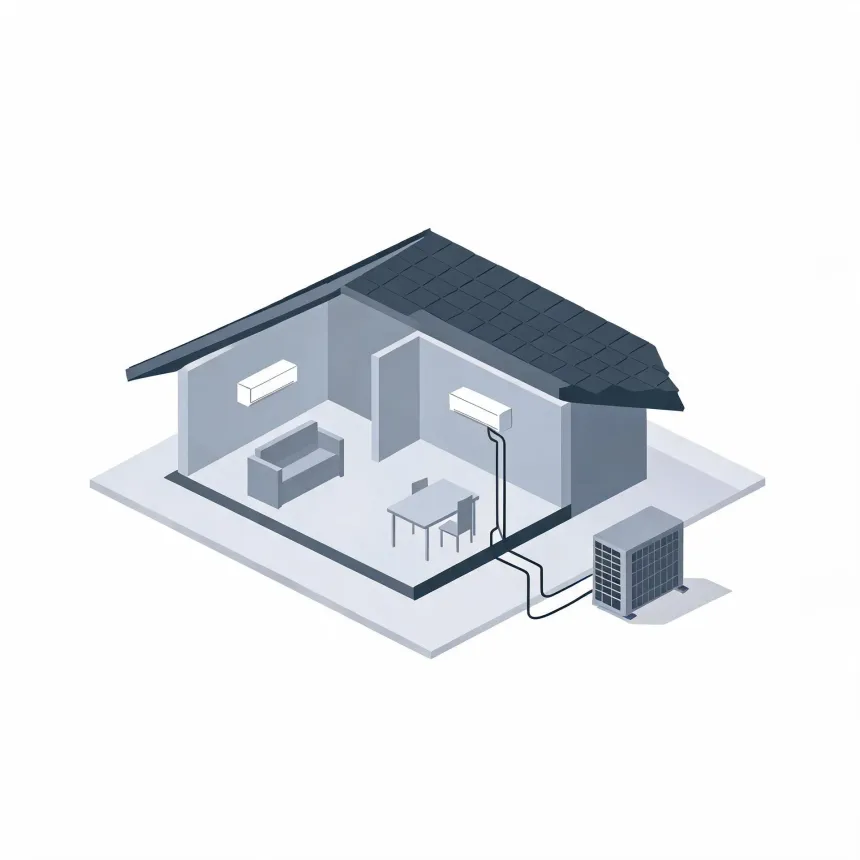
Isometric illustration of a cutaway house interior with sofa, table and chair, two wall-mounted indoor air conditioning units connected by lines to an outdoor condenser unit beside the building.
Your system heats November through March and cools May through September.

NOAA nClimDiv, 1991–2020 normals

Gas heats half the homes in Pulaski County.

A mini split works alongside that furnace or replaces electric heat strip for strip, so either way it has to carry the load on its own when it's running.

April is the month to get this done, before May's heat and the storms behind it arrive

Cooling runs May through September
Summer afternoons average 91°F
178 damaging wind events from 2015 to 2024
A standard mini split does the job in Little RockElectricity runs 12.32 cents a kilowatt-hour here, and a standard size and efficiency covers this job.

The equipment itself is only part of the bill. Where the outdoor unit sits matters, because the line set connecting it to the indoor head has to run through a wall, and a longer run or an extra bend in that line adds labor and material. Every indoor head needs its own path for refrigerant lines, a condensate drain, and a power connection, so a single-zone system costs less to put in than a multi-zone system feeding several rooms. The electrical side matters too. Some mini splits can run on an existing circuit, while others need a new dedicated circuit and breaker, and that work adds to the job. Mounting also plays a part, since a wall-mounted head goes in faster than a ceiling cassette or a ducted air handler tucked into a soffit or closet.

Plan for storms

Storms and outages are common here. Plan where the outdoor unit goes, how it's protected, and how you'll keep heat and hot water in an outage.

Find a contractor
A white mini-split air conditioner outdoor condenser unit mounted on metal brackets against a beige stucco exterior wall, with a blue sky and scattered clouds in the background.

Get the size right before anything else

Have the contractor run a load calculation on this house, not a rule of thumb based on square footage. That number sets the size of the outdoor unit and the head. Undersized and it runs flat out all summer without catching up on the worst afternoons. Oversized and it short cycles, cooling the room fast but never running long enough to pull the humidity down. Either way you feel it on the hottest days, which here run from May through September.

The load calculation, not the floor plan

A contractor works out capacity from the walls, the windows, the ceiling height and the insulation behind the drywall, not from square footage alone. Homes that look the same size on paper can need different equipment once those details are weighed. That number, not a rule of thumb, is what should set the size of the outdoor unit and the head.

Each head carries its own room

In a multi-zone system, every indoor head is sized to the space it serves. One sized too large for its room cools the air fast and shuts off before it pulls the moisture out, so the room feels cool but damp. One sized too small runs without stopping and still falls behind on the hardest afternoons. Getting it wrong in just one room is enough to notice.

Whoever installs the new system still has to deal with the old one. A central system coming out means an indoor coil, an outdoor unit, a line set, and in most homes a furnace or air handler, all of which get disconnected and hauled away. The refrigerant inside that old outdoor unit has to be recovered before the lines come apart, not vented, so that part of the job falls to the contractor doing the removal rather than a hauling service. If ductwork stays in place for the new mini split to tie into in any way, it gets inspected first, since old duct runs built for a central system don't always suit the new one. None of this is a reason to delay. It just means removal is part of the installation, not a separate job you arrange on your own.

Installation day starts with the outdoor unit and works inward. The contractor sets the outdoor unit on a pad or wall brackets first, in the spot chosen ahead of time, then runs the line set through the wall to each indoor head. That penetration gets sealed once the lines are through, so weather and pests stay out. Each indoor head gets mounted to a bracket on the wall or ceiling, then connected to its refrigerant lines, condensate drain, and power. Once everything is in place, the system gets evacuated to pull out moisture and air, then charged with refrigerant to the manufacturer's specification. The last step is running the system through its paces, checking airflow at each head and confirming it holds the temperature it's set to before anyone calls the job done.