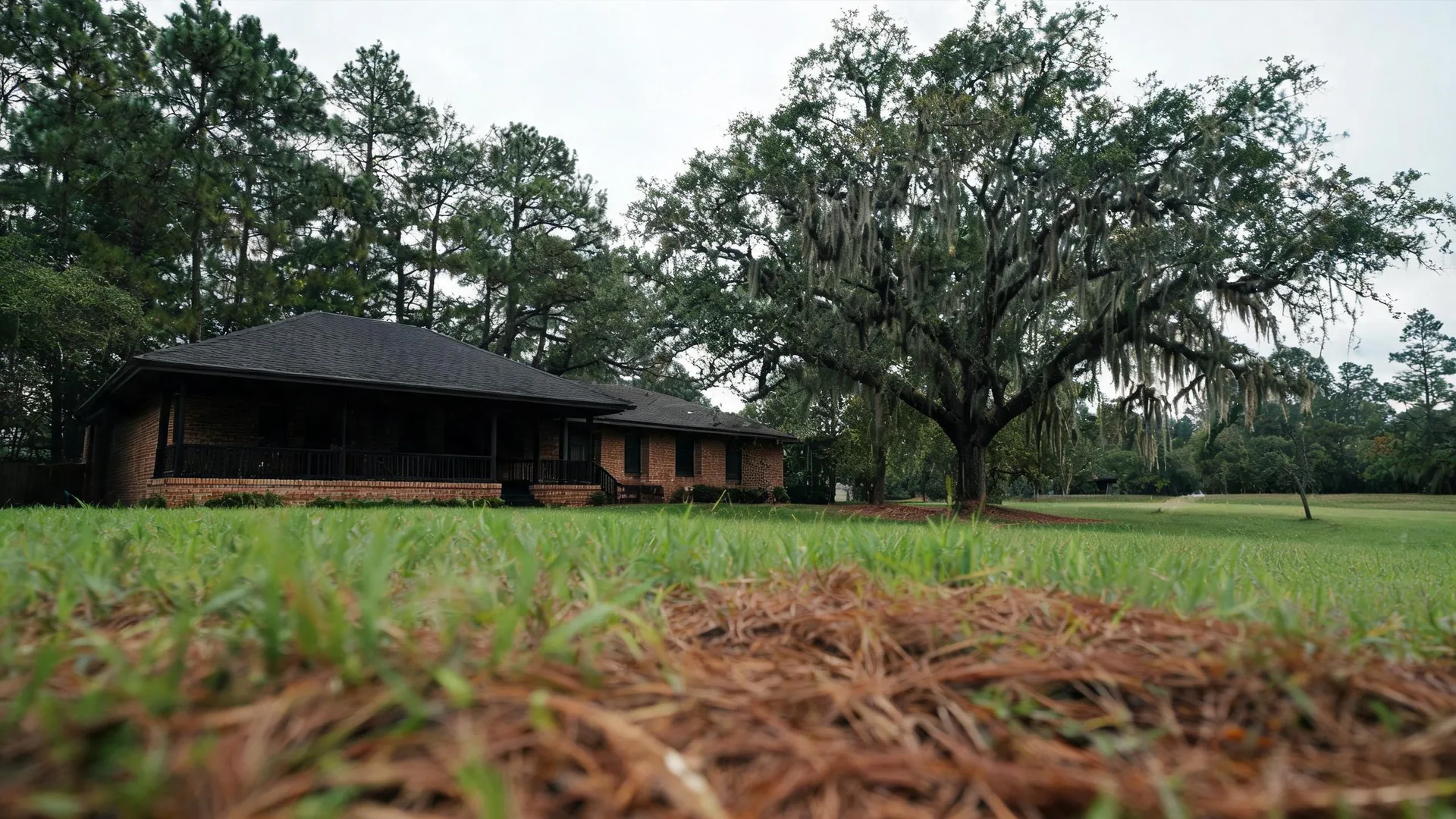
Low-angle view across a lawn with pine straw in the foreground toward a single-story brick house with a dark shingled roof and covered porch, beside a large moss-draped oak and pine trees under an overcast sky.

AC Repair in Monticello, AR

Tell us about the job

Takes about a minute. No obligation.

RepairCentral ACDrew County, AR
Step 1 of 2

What ZIP code is the job in?

Warm air from the vents means the system isn't cooling, not just struggling

A unit that runs but blows warm air usually has a refrigerant leak, a failing compressor, or a frozen evaporator coil that's thawed back out. This isn't a problem that gets better on its own, and running the system in this state can push a bad compressor toward total failure.


Short cycling wears out the parts that start the system

If the AC kicks on, runs a few minutes, then shuts off and starts again, something is cutting the cycle short. That's hard on the compressor and the capacitor that drives it. Each short cycle is like a cold start, and cold starts are what wear those parts down fastest.

5 months
May through September, your air conditioner is on duty
91°F
the average summer afternoon it cools against
15 hail events
in ten years, and hail bends the fins on outdoor coils
46 wind events
in ten years, and wind drives debris into outdoor units
Isometric line illustration of a cutaway house showing an indoor air handler with branching ducts in the attic space, connected by a line set to an outdoor condenser unit beside the building, with simple furniture in two rooms.
Your air conditioner works hardest from June through September.

NOAA nClimDiv, 1991–2020 normals

An AC repair can mean swapping one part or facing a compressor that's not worth saving.

The age of the system and the part that failed together decide which one this is.

Half the homes in Drew County date to 1985 or earlier, nothing here is unusual for an AC

Half the homes here were built by 1985
Climate zone 3A
Power costs 12.32 cents a kWh statewide

Cooling here runs May through September, after a slower month in April. The first real hot stretch is when a weak part finally gives out. A capacitor that's been fading all winter can't start the compressor once the system is working hard every day. A refrigerant charge that was a little low in spring can't keep the house cool once the load is real. If the AC struggled by the end of last season, the same part is often what fails first this year, and it tends to go earlier once the heat sets in.

The fix is usually simple. Waiting on it isn't free.

A capacitor or a compressor costs the same to replace here as anywhere else in Arkansas. The electric bill while you wait it out doesn't. Arkansas homes paid 12.32 cents per kilowatthour in 2024, and a struggling AC draws more of it trying to do a job a weak part can't finish. Getting the right part swapped now stops that waste and gets the house cool again.

Find a contractor
A man seen from behind in a dark shirt and tan work pants carries a canvas tool bag up wooden steps toward a green front door of a shingled house.
A gray cylindrical air conditioning condenser unit mounted on a concrete pad next to a light-colored vinyl-sided house exterior.

Five months of this, every year

Five months of cooling here, and 91 degrees most afternoons in the thick of it. That's the stretch from May through September, with the compressor working close to flat out most days. A system built for occasional use doesn't get that kind of load anywhere else in the year. Parts that were already weak don't get a break to recover, they just keep taking the same strain day after day. That's why trouble tends to show up earlier here than the manual would suggest.

A low charge keeps pulling the compressor down

A refrigerant leak doesn't hold steady. The charge keeps dropping, and the compressor has to work harder to move what's left. It runs hotter than it was built to, and that heat is what ends up killing it.

A frozen coil needs the system off, not on

Once a coil ices over, running the system longer doesn't push past the problem. It buries the coil under more ice and starves airflow further. The coil needs time off to thaw clean before anyone can even tell what caused it to freeze in the first place.

Overhead view of a gray outdoor AC condenser unit on a concrete pad beside a mulched garden bed and a house with vinyl siding.

A new air conditioner would cut about $50 a year off cooling for a typical Drew County home.

  • A new one at the federal minimum, 14.3 SEER2$370 a year
  • An older air conditioner$420 a year

Estimates for a typical Drew County home, compared with an older unit built to the previous federal minimum, from EIA household energy data, Arkansas fuel prices and NOAA climate normals. Your home will differ.

Repair makes sense when a part like a capacitor or contactor has failed.

Replacement makes sense when the compressor has failed or the system uses R-22 refrigerant, which is no longer made.

A diagnostic starts with gauges, not guesses. The tech connects them to the service ports and checks the refrigerant pressure on both sides. That one reading points toward a leak, a bad compressor, or a restricted coil before anything gets taken apart. From there it's the electrical side. The capacitor gets tested under load against what's stamped on it, the contactor gets checked for pitting, and the compressor's amp draw gets measured against what it should be pulling. A weak capacitor can look fine sitting in its case. It has to be working to show what it can't do anymore. The indoor coil and the airflow across it get checked too, since a coil that's iced over or starved for air can look like a refrigerant problem that isn't really there. By the end, the tech can usually point to the one part that's failing instead of swapping parts to see what helps.