






A white Southern-style house with a wraparound porch photographed at night, surrounded by Spanish moss-draped oak trees lit by landscape lights.

AC Repair in Malvern, AR

Tell us about the job

Takes about a minute. No obligation.

RepairCentral ACHot Spring County, AR
Step 1 of 2

What ZIP code is the job in?

A refrigerant leak is a good example of a problem that gets worse the longer the system runs. A low charge makes the compressor work harder than it should, and that heat has nowhere to go but back into the compressor itself. Run it long enough on a low charge and you can burn out the compressor entirely, which turns a simple leak repair into a full system replacement. The same goes for a dirty condenser coil. Restricted airflow across that coil raises the head pressure, and the compressor strains against it every time it cycles on. A frozen evaporator coil is another one. Once ice builds up, airflow drops further, more ice forms, and the compressor can end up trying to pump refrigerant through a blocked line. Shutting the system off as soon as something seems off gives the parts most at risk a chance to cool down and stay intact.

5 months
May through September, your air conditioner is on duty
91°F
the average summer afternoon it cools against
26 hail events
in ten years, and hail bends the fins on outdoor coils
45 wind events
in ten years, and wind drives debris into outdoor units
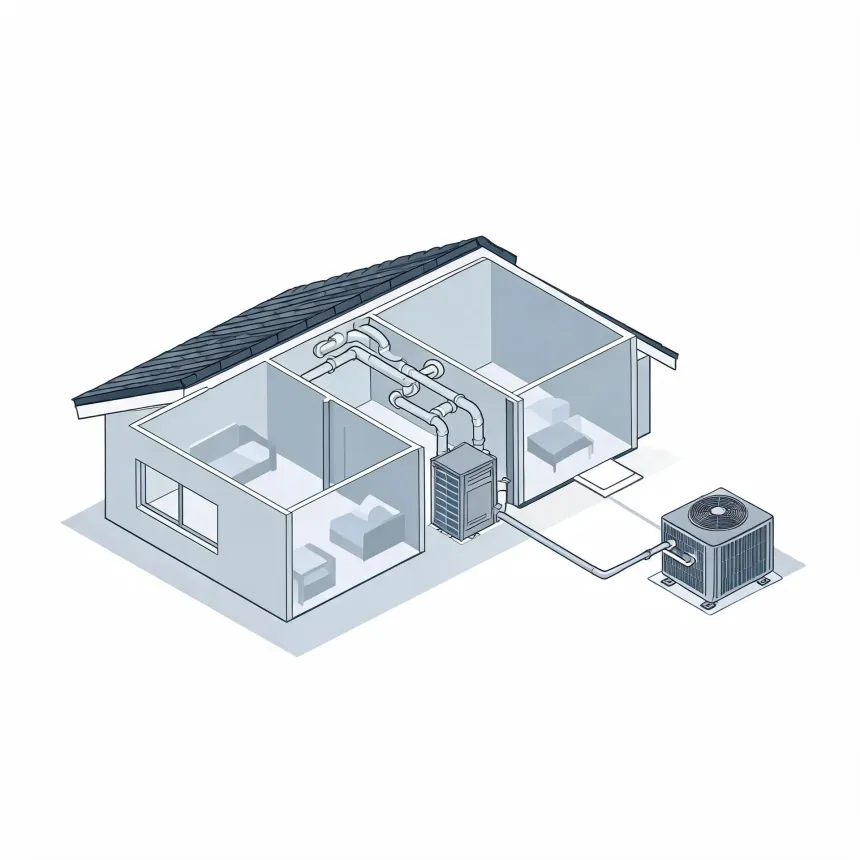
Isometric line illustration of a cutaway single-story house showing interior rooms, ductwork, an indoor air handler or furnace, and a refrigerant line running to an outdoor condenser unit on a pad.
Your air conditioner works hardest from June through September.

NOAA nClimDiv, 1991–2020 normals

May is when cooling starts in Malvern, and it's when a weak part gets found out.

If your AC made it through last September fine, get it checked in April before the first hot week decides for you.

Hot Spring County's weather is ordinary. What breaks in your AC usually isn't the weather, it's wear.

83 severe weather events from 2015 to 2024
24% of homes statewide lost power a day or more in 2024
45 damaging wind events from 2015 to 2024
The house age tells you where to lookHalf the homes here were built in 1979 or earlier, old enough that the AC has likely been swapped at least once.

Before calling anyone, check the thermostat is set to cool and the temperature is actually below room temperature. Go to the breaker box and make sure the AC breaker hasn't tripped. Look at the outdoor unit and clear away any leaves, grass clippings or debris sitting against the fins. Pull the filter and hold it up to a light. If you can't see through it, swap it for a new one, since a clogged filter chokes airflow and can freeze the coil. Check the vents in each room and make sure none of them are closed or blocked by furniture. If you see ice anywhere on the refrigerant lines or the indoor coil, turn the system off and leave it off until someone looks at it.

Five months of running hard wears a system down

Cooling runs May through September here, and June through August the afternoon high averages 91°F. That's five months of long run times a year, and it adds up to wear faster than it would somewhere milder. Have the actual cause diagnosed rather than guessed at, so whatever gets fixed this time stays fixed.

Find a contractor
A man in a cap, dark long-sleeved shirt and brown work pants carries a canvas tool bag as he climbs porch steps toward a green front door.
An outdoor residential air conditioning condenser unit mounted on a concrete pad, surrounded by gravel with a blue sky in the background.

Nothing fails all at once. Parts wear down the same way every time.

An air conditioner doesn't fail from one thing. It fails from the same parts wearing down the same way, year after year, until one of them gives out. The capacitor is the usual first casualty. It stores the charge that kicks the compressor and fan motor into motion, and that charge weakens a little every time it's used. Eventually it can't deliver enough of a jolt, the compressor hums but doesn't start, and the whole system stalls on startup. Contactors wear out next, the switch contacts inside get pitted from arcing every time the unit cycles on, until they stick or stop making contact at all. Bearings in the fan motor dry out over time and the motor starts working harder to spin, drawing more current than it should until it finally seizes. None of this happens because a system had a bad month. It happens because these are mechanical parts doing the same job over and over, and mechanical parts wear.

Warm air from the vents means the system is losing the fight

If the air coming out isn't cold anymore, or it's cold for a while then turns warm, something is already struggling, whether that's the compressor, the charge, or airflow across the coil. This isn't a wait and see sign. A system blowing warm air is usually working just as hard as ever and getting nothing for it.

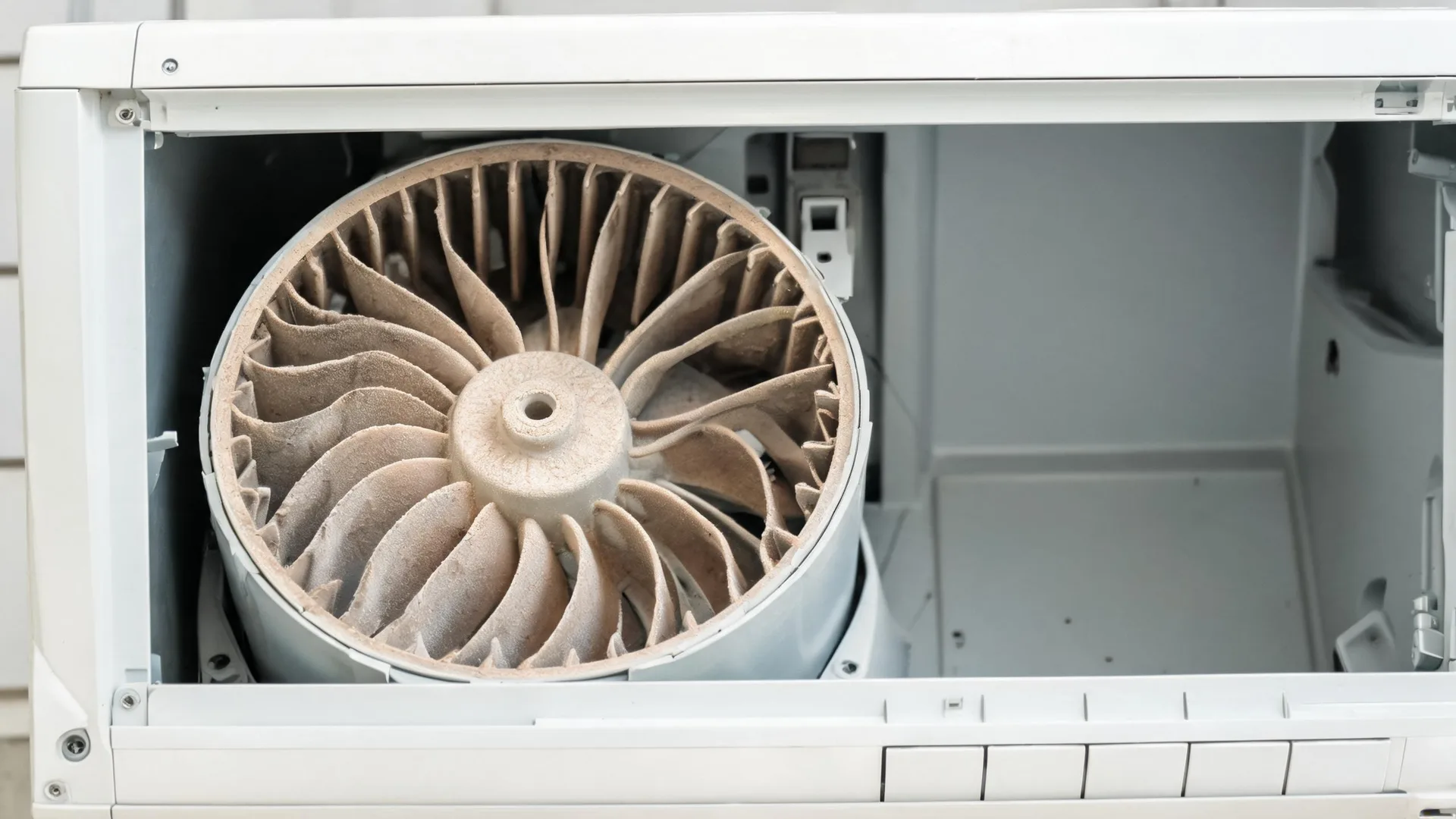
A new sound is the machine telling you what's wrong

A hum with no start, a hard bang on startup, a squeal from the fan, a rattle that wasn't there before, each one points to a different part. The sound alone won't tell you which part, but it tells you to get someone out before the part that's struggling takes another one down with it.

Aerial view of a square outdoor air conditioning condenser unit on a concrete pad beside a house wall with a sliding glass door.

A new air conditioner would cut about $50 a year off cooling for a typical Hot Spring County home.

  • A new one at the federal minimum, 14.3 SEER2$340 a year
  • An older air conditioner$390 a year

Estimates for a typical Hot Spring County home, compared with an older unit built to the previous federal minimum, from EIA household energy data, Arkansas fuel prices and NOAA climate normals. Your home will differ.

Repair makes sense when a part like a capacitor or contactor has failed.

Replacement makes sense when the compressor has failed or the system uses R-22 refrigerant, which is no longer made.

A repair is worth doing when one part failed and everything else is sound. A replacement makes sense when the system is asking you to keep fixing one part after another, because that pattern usually means the whole system is wearing down at once, not just the piece that happens to have quit first. Age matters less than what's actually worn. A compressor that's overheated from running low on charge, or one that's seized from a bad bearing, is a different situation than a bad capacitor in a system that's otherwise been fine. The compressor is the part that decides this more than any other, since it's the most expensive part to replace and the hardest to justify replacing on its own. If a contractor tells you the compressor is going, that's usually the point where fixing it and replacing the system cost about the same, and only one of those gets you a warranty on the whole thing.