







An outdoor air conditioning condenser unit positioned on a concrete pad next to a blue-sided house, surrounded by green shrubs and flowering hydrangeas at sunset.

AC Repair in Forrest City, AR

Tell us about the job

Takes about a minute. No obligation.

RepairCentral ACSt. Francis County, AR
Step 1 of 2

What ZIP code is the job in?

Cooling runs May through September in St. Francis County, about five months straight. June through August, the afternoon high averages 90°F, and the system has to hold against that heat for hours every day. That kind of stretch wears on parts faster than a mild climate would. A capacitor or a contactor that might last years somewhere cooler can wear out sooner after summers like this. When something starts acting up, it's worth having it looked at properly rather than guessing, because the heat that wore the part down the first time is still out there.

5 months
May through September, your air conditioner is on duty
90°F
the average summer afternoon it cools against
2 hail events
in ten years, and hail bends the fins on outdoor coils
21 wind events
in ten years, and wind drives debris into outdoor units
Isometric cutaway illustration of a single-story house showing interior ductwork and an air handler connected by lines to an outdoor condenser unit on a pad beside the building.
Your air conditioner works hardest from June through September.

NOAA nClimDiv, 1991–2020 normals

Electricity in Arkansas ran 12.32 cents per kilowatt-hour in 2024.

A failing capacitor or a dirty coil makes the system run longer to do the same job, and that shows up on the bill before anyone diagnoses the cause.

May is when the weak part gives out

Cooling runs May through September
Summer afternoons average 90°F
Power costs 12.32 cents a kWh statewide
Half these homes were built in 1980 or earlierThe system in an older house isn't automatically the problem here. 13.5% of homes in the county are mobile homes, which cool differently than a site-built house.

If your AC is struggling right now, don't just top it off with a quick fix and hope it holds. A technician who knows what five months of 90 degree afternoons does to a system can find the part that's actually failing instead of the symptom it's causing. A weak capacitor can look like a thermostat problem. A dirty coil can look like a failing compressor. Get it checked properly and the fix holds for the rest of the summer, not just the next hot day.

Get it diagnosed properly

Your air conditioner works hard here, and that's usually what's behind the problem. Have it diagnosed properly so the fix lasts.

Find a contractor
A man in a dark T-shirt and tan work pants, carrying a canvas tool bag, walks up wooden steps toward a green front door flanked by white siding and a potted shrub.
An outdoor residential air conditioning condenser unit mounted on a concrete pad, surrounded by gravel with a blue sky in the background.

What to check before you call

Before anyone comes out, a few things are worth checking yourself. Look at the thermostat first. Make sure it's set to cool and set lower than the room temperature, and check the batteries if it uses them. Next, go to the breaker panel and see if the AC breaker has tripped. If it has, reset it once. If it trips again, leave it off and mention that when you call. Check the outdoor unit. If the fan isn't spinning and you don't hear a hum, that points to a different problem than if it's running but the air inside is still warm. Look at the air filter. A filter clogged with dust chokes off airflow and can make the whole system struggle, and it's the one part you're meant to check yourself anyway. Check for ice on the indoor coil or the refrigerant lines. If you see frost or ice anywhere, turn the system off at the thermostat and let it thaw completely before anyone touches it further, because running it iced up can damage the compressor. Last, check the outdoor condenser for anything blocking it, leaves, grass clippings, a fallen branch, and clear it away if there is. None of this tells you exactly what's wrong, but it tells the technician what you've already ruled out.

The capacitor goes first, most often

The capacitor gives the compressor and fan motor the jolt they need to start, and it's the part under the most electrical strain in the whole system. Heat shortens its life faster than almost anything else out there. When it weakens, the fan may spin slowly or the compressor may hum and not start at all, and the whole unit can stop cooling even though the breaker never trips.

A dirty coil hides as something worse

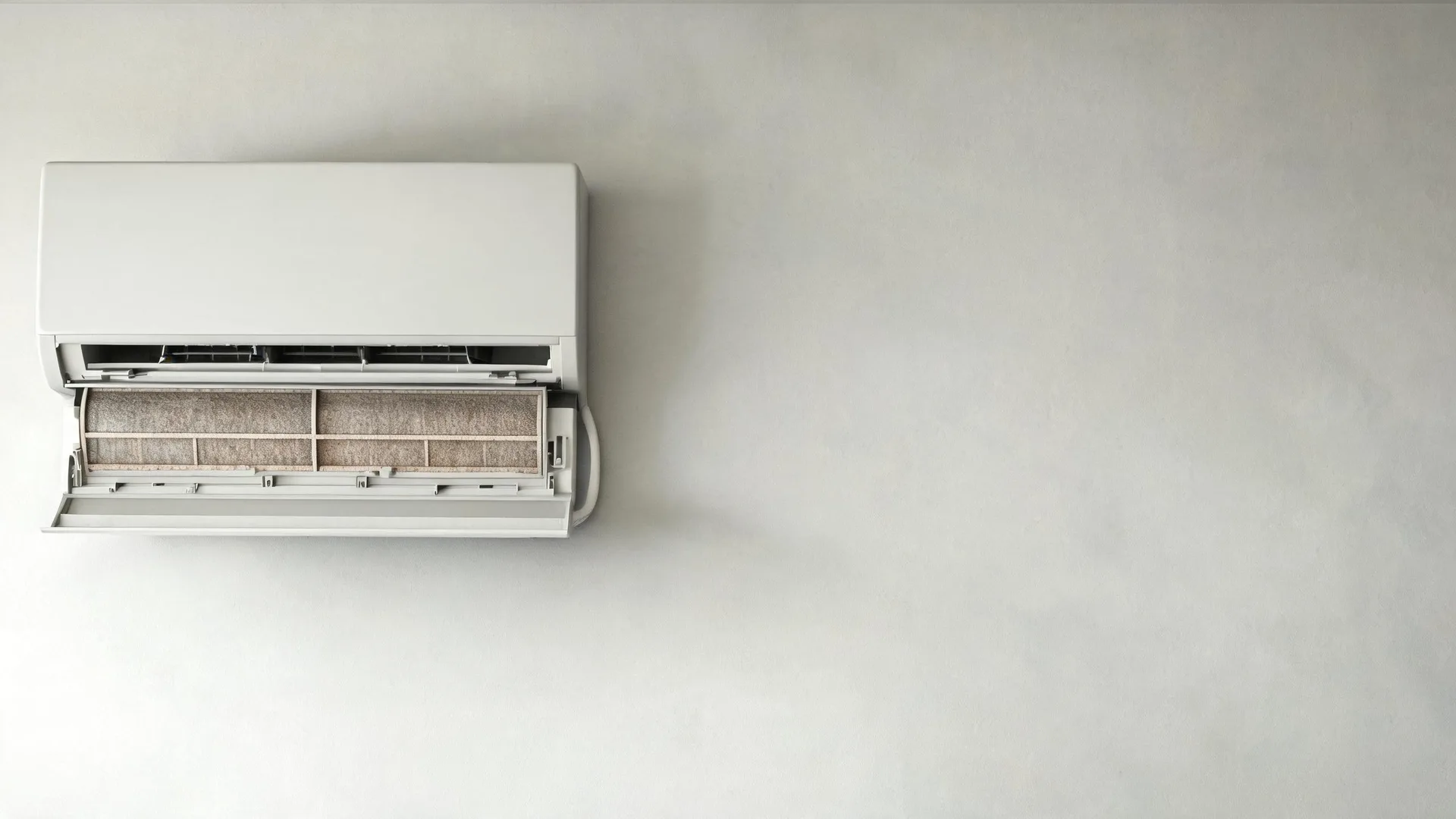
The outdoor coil has to shed heat and the indoor coil has to absorb it, and dust or grime on either one makes the system work harder to do the same job. Left alone, a dirty coil raises the pressure in the refrigerant lines, and over time that strain is what actually burns out a compressor. What looks like a failing compressor often started as a coil nobody cleaned.

Aerial view of a square outdoor air conditioning condenser unit on a concrete pad beside a house wall with a sliding glass door.

A new air conditioner would cut about $50 a year off cooling for a typical St. Francis County home.

  • A new one at the federal minimum, 14.3 SEER2$350 a year
  • An older air conditioner$400 a year

Estimates for a typical St. Francis County home, compared with an older unit built to the previous federal minimum, from EIA household energy data, Arkansas fuel prices and NOAA climate normals. Your home will differ.

Repair makes sense when a part like a capacitor or contactor has failed.

Replacement makes sense when the compressor has failed or the system uses R-22 refrigerant, which is no longer made.

A diagnostic visit starts outside at the condenser, checking that the fan spins freely and the compressor cycles on without hesitating or humming. The technician checks the capacitor's charge, since a weak one is the most common reason a unit won't start right even though power is reaching it. Refrigerant pressure gets checked at the lines, because too little or too much both point to a specific problem rather than a guess. Inside, the coil gets checked for ice or buildup, and the airflow gets traced back through the filter and the ducts to see if the system is moving the air it's supposed to. Electrical connections get checked for corrosion or looseness, since a loose wire can mimic a failing part and send someone chasing the wrong fix. The goal is to find the one part actually causing the problem, not just the part showing the symptom.