





A low-angle view along a red brick wall with shrubs at its base, facing a mown grass lawn with a single-story light-colored house and pine trees under an overcast sky.

AC Repair in Conway, AR

Tell us about the job

Takes about a minute. No obligation.

RepairCentral ACFaulkner County, AR
Step 1 of 2

What ZIP code is the job in?

Faulkner County saw 174 severe weather events between 2015 and 2024, and damaging wind and hail made up most of those. Either one can hit an outdoor AC unit hard enough to bend fins, crack a fan blade, or knock a panel loose, and the unit can keep running for a while after with damage like that sitting unfixed. If your system took a hit from a storm and still runs fine, it's worth having a contractor look it over anyway. Power cuts matter too. Nearly a quarter of Arkansas households lost power for a day or more in 2024, and a hard outage can be rough on a system even after the power comes back on.

5 months
May through September, your air conditioner is on duty
91°F
the average summer afternoon it cools against
64 hail events
in ten years, and hail bends the fins on outdoor coils
90 wind events
in ten years, and wind drives debris into outdoor units
Isometric grayscale illustration of a cutaway house with the roof lifted, showing interior rooms, ductwork, an indoor air handler, and an outdoor condenser unit beside the building.
Your air conditioner works hardest from June through September.

NOAA nClimDiv, 1991–2020 normals

AC here starts running in May.

Have it looked at in April, before the first real load finds the weak spot.

Half the homes here were built in 1998 or later, so the AC is often worth fixing

Half the homes here were built by 1998
Cooling runs May through September
Summer afternoons average 91°F

Most AC problems in Conway are not storm damage. A capacitor weakens, a contactor wears out, the refrigerant charge drops a little, and the unit struggles to keep up once it has to run hard. None of that has anything to do with wind or hail. It is just a part reaching the end of its life. A contractor checking a system after months of sitting idle, or after the first hot stretch, is usually looking for exactly that kind of ordinary wear. Electricity here ran 12.32 cents per kilowatthour in 2024, so a system working harder than it should to cool the house shows up on the bill, not just in the air coming out of the vents.

Summers here don't let an AC coast

Five months of cooling a year, afternoon highs averaging 91°F through the summer. That's the stretch your AC has to get through, and it does the heavy lifting in June, July and August when there's no letting up. A system working that hard every summer wears sooner than one that gets a break. When something's off, it's worth finding out what before the next hot stretch asks more of it.

Find a contractor
A man in a cap, gray T-shirt and tan work pants carries a worn leather tool bag up wooden porch steps toward a green front door.
A gray cylindrical air conditioning condenser unit mounted on a concrete pad next to a light-colored vinyl-sided house exterior.

Parts fail from use, not from age

Most AC failures trace back to the same handful of parts, and they fail from running, not from age on the calendar. A capacitor is rated for a certain number of start and run cycles, and every cycle uses a little of that up. More cycles means the capacitor gets there sooner. A contactor's points pit a little more each time they close, until they stick or stop making contact. Refrigerant doesn't get used up, but a slow leak at a fitting or coil pinhole lets a little out each season, and a system low on charge runs longer to do the same job, which puts more hours on everything else. Dirt and dust work the same way, building up on the outdoor coil or the indoor coil a little at a time until the system can't shed heat the way it was designed to. None of these show up as a sudden break. They show up as a system that runs a little longer each week to do the same job, right up until the part gives out.

A weak part doesn't stay weak

A capacitor that's starting to go still kicks the compressor on, so the system keeps running. But every start pulls harder on it than it should, and that strain adds up each time the unit cycles. A contactor with pitted points still closes the circuit, until the day it doesn't.

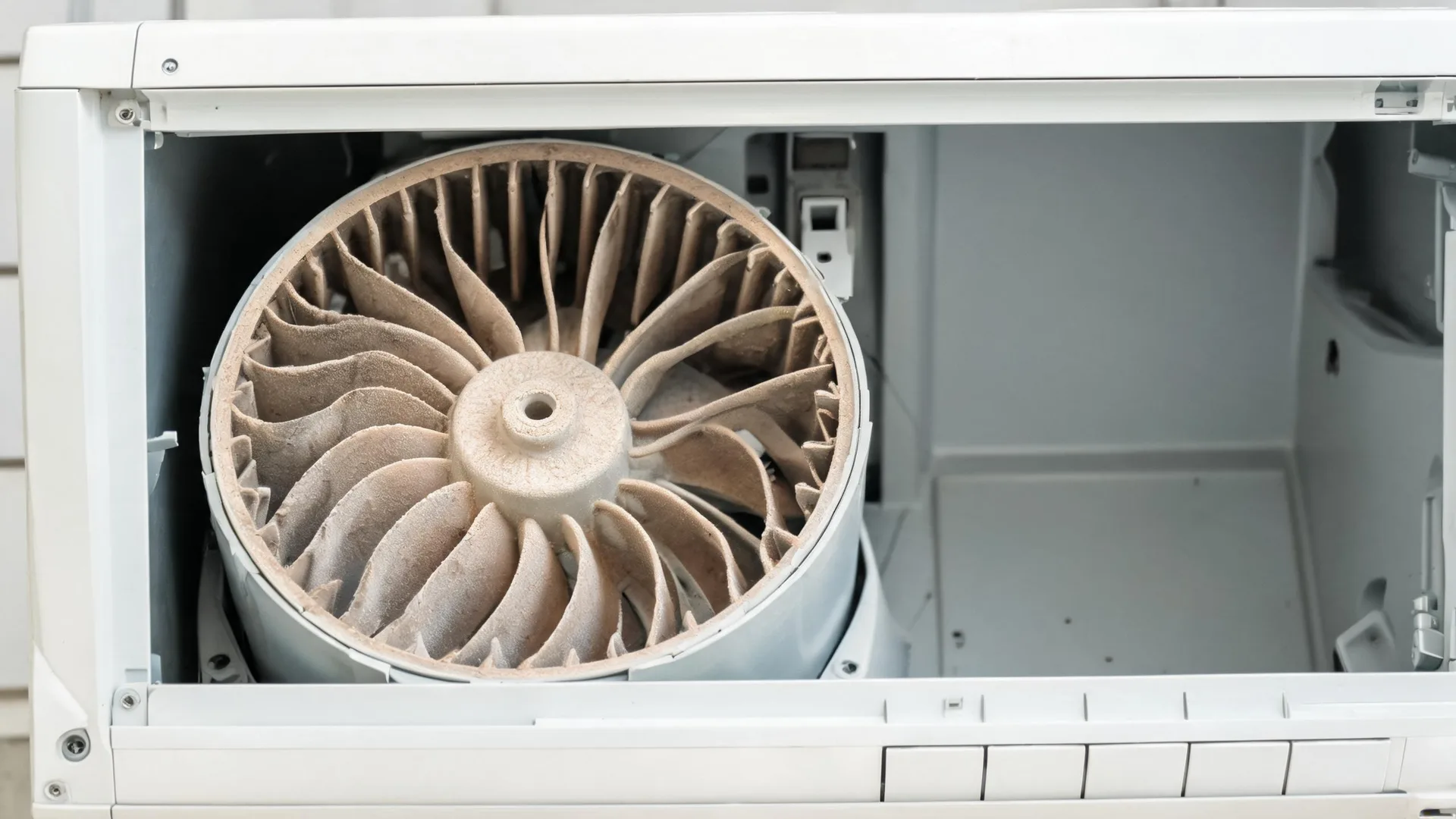
The compressor pays for it

A low refrigerant charge or a dirty coil makes the compressor work harder to move the same amount of heat out of the house. Run it like that through a full stretch of hot days and the compressor is the part absorbing the extra strain, cycle after cycle, with no break to recover.

An outdoor air conditioning condenser unit installed beside the exterior wall of a blue vinyl-sided house at sunset.

A new air conditioner would cut about $50 a year off cooling for a typical Faulkner County home.

  • A new one at the federal minimum, 14.3 SEER2$320 a year
  • An older air conditioner$370 a year

Estimates for a typical Faulkner County home, compared with an older unit built to the previous federal minimum, from EIA household energy data, Arkansas fuel prices and NOAA climate normals. Your home will differ.

Repair makes sense when a part like a capacitor or contactor has failed.

Replacement makes sense when the compressor has failed or the system uses R-22 refrigerant, which is no longer made.

A diagnostic visit starts outside, at the condenser, before anyone touches a gauge. A contractor will pull the panel and look at the capacitor, the contactor, the wiring, checking for anything scorched, swollen, or pitted. Then comes the refrigerant charge, checked against what the system is supposed to be running, along with the pressures on both sides of the line. Inside, they'll check the coil and the airflow coming off the blower, since a system can show the exact same symptom, warm air, a short cycle, ice on the line, for several different reasons. The point of the visit is to find which part is actually failing, not just which one might be, so the fix addresses the real problem instead of guessing at it.