






White two-story houses with wraparound porches and Spanish moss-draped oak trees photographed along a residential street at night.

AC Repair in Booneville, AR

Tell us about the job

Takes about a minute. No obligation.

RepairCentral ACLogan County, AR
Step 1 of 2

What ZIP code is the job in?

AC here runs May through September, five months a year. June through August, the afternoon high averages 90 degrees, and the unit has to keep up with that heat most of the day. That kind of stretch wears on a system faster than it would somewhere milder. The capacitor, the contactor, the fan motor all cycle more than they would in a cooler climate. When something finally acts up, it's usually because a part that's been working hard for years wore down to the point of failing. A proper diagnosis finds which part that is instead of guessing.

5 months
May through September, your air conditioner is on duty
90°F
the average summer afternoon it cools against
29 hail events
in ten years, and hail bends the fins on outdoor coils
55 wind events
in ten years, and wind drives debris into outdoor units
Isometric line illustration of a cutaway single-story house showing interior rooms, ducted air handler, ceiling ductwork, and an outdoor condenser unit connected by refrigerant lines.
Your air conditioner works hardest from June through September.

NOAA nClimDiv, 1991–2020 normals

Logan County saw 55 damaging wind events and 29 hail events over the past decade.

Weather like that isn't why your AC quit. Wear on a part that's run hard every summer is.

May's early heat finds the weak part first

Cooling runs May through September
Summer afternoons average 90°F
Power costs 12.32 cents a kWh statewide
Booneville homes aren't oldHalf the homes in Logan County were built in 1979 or later.

If your AC is struggling right now, don't keep running it and hope it sorts itself out. A system cycling constantly against a 90 degree afternoon will push a weak part the rest of the way to failure. A contractor can check the capacitor, the contactor and the fan motor and find which one is actually worn out. That's a better path than swapping parts on a guess. The sooner it's looked at, the less chance it quits on you in the middle of the next hot stretch.

A newer system is usually worth repairing

If your AC came with the house, it's worth getting the actual part fixed rather than planning around a replacement. A newer system still has a worn capacitor or contactor behind most breakdowns, not a system near the end of its life.

Find a contractor
An outdoor air conditioning condenser unit mounted on a concrete pad beside a house, with electrical conduit running to a wall-mounted disconnect box.

A part that's struggling now won't hold out on its own

A failing capacitor doesn't fail all at once. It weakens, and the compressor starts pulling harder to get going each time it cycles on. Keep running it in that state and the compressor motor takes on the strain the capacitor should be absorbing. A contactor with pitted contacts works the same way. It arcs a little more each cycle, gets hotter, and eventually sticks or burns through. A refrigerant leak is worse left alone than almost anything else. The system keeps running low on charge, the compressor runs hotter than it should, and what started as a slow leak can end with a compressor that won't run at all. None of these fix themselves by giving the system a break. They get worse on the next cycle, and the next.

What you can check yourself

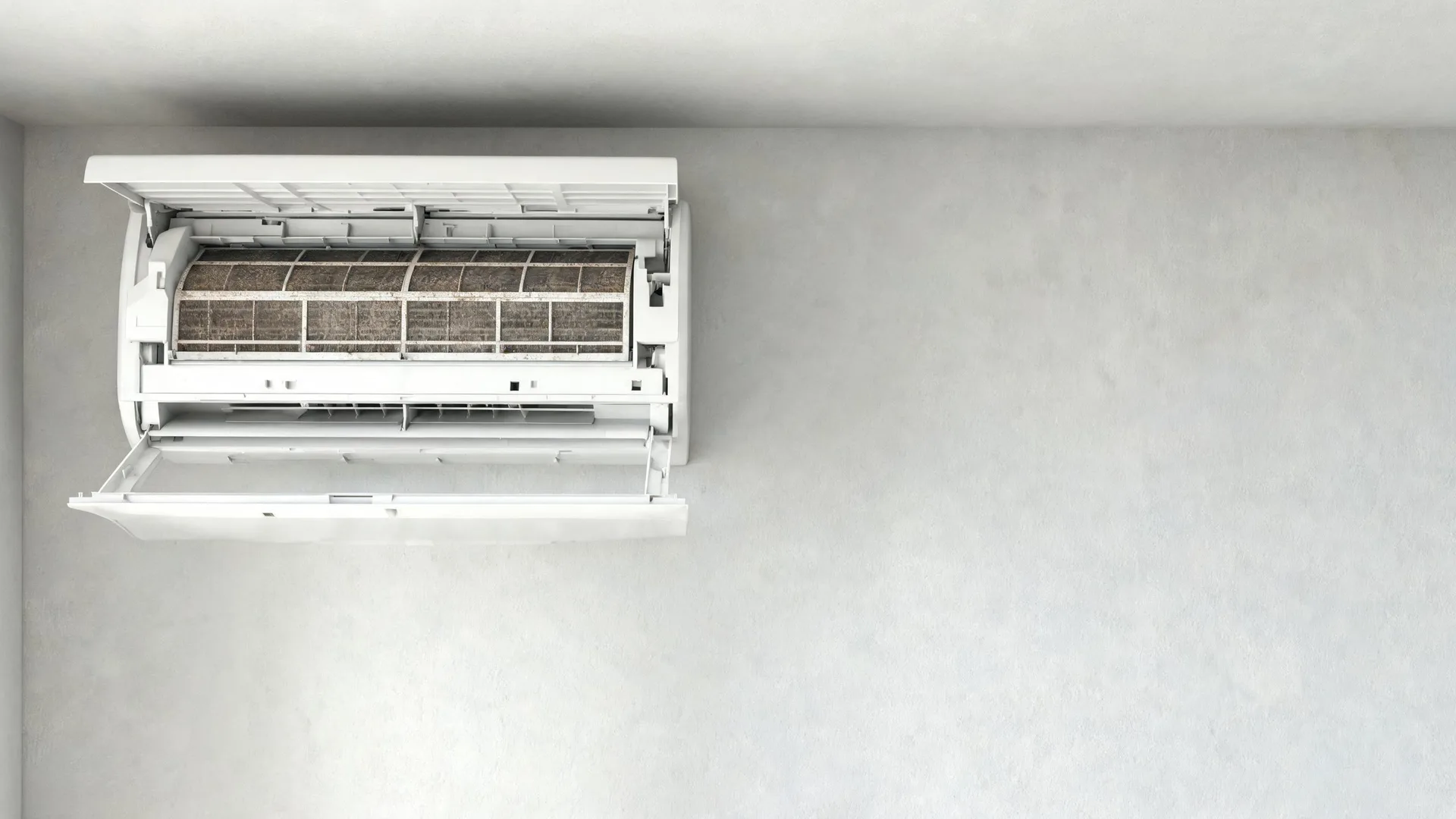
Check the thermostat is set to cool and set below room temperature. Look at the outside unit and see if the fan is spinning. Check the breaker box for a tripped breaker. Pull the air filter and hold it up to light. If you can't see light through it, that's restricting airflow across the coil and worth fixing before anything else.

What to leave alone

Don't pull the access panel on the outside unit or touch the wiring inside it. The capacitor in there holds a charge even with the power off. Don't add refrigerant yourself or keep running the system if ice has built up on the coil or lines. Shut it off and let it thaw. Running it iced up pushes the compressor harder than it's built to take.

An outdoor central air conditioning unit mounted on a concrete pad beside a blue-sided house at sunset.

A new air conditioner would cut about $50 a year off cooling for a typical Logan County home.

  • A new one at the federal minimum, 14.3 SEER2$310 a year
  • An older air conditioner$360 a year

Estimates for a typical Logan County home, compared with an older unit built to the previous federal minimum, from EIA household energy data, Arkansas fuel prices and NOAA climate normals. Your home will differ.

Repair makes sense when a part like a capacitor or contactor has failed.

Replacement makes sense when the compressor has failed or the system uses R-22 refrigerant, which is no longer made.

Age is the real question when you're deciding whether to fix or replace. A system still inside its expected service life is almost always worth repairing, even for something major like a compressor, because the rest of the unit still has years in it. Past that point, the math changes. A refrigerant leak or a second major repair on an old system is often the signal to stop patching it. The coil and compressor are the expensive parts, and if one of those is failing on a unit that's already old, putting money into it just delays the same decision. Ask what's actually broken before assuming the whole system is done. A capacitor or contactor is a small, cheap fix regardless of the unit's age. It's only when the compressor itself is the problem that age starts to matter.