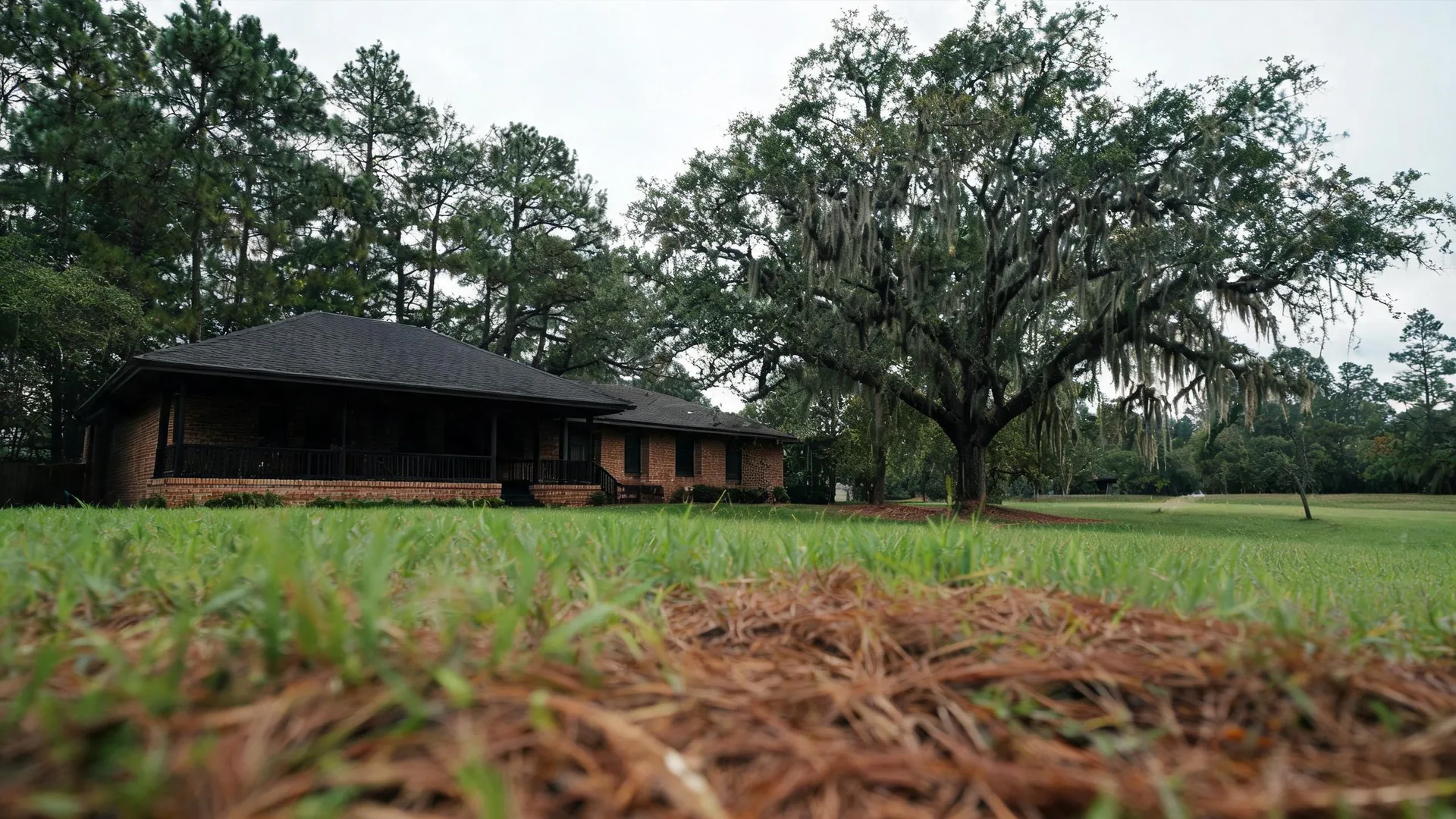
Low-angle view across a lawn with pine straw in the foreground toward a single-story brick house with a dark shingled roof and covered porch, beside a large moss-draped oak and pine trees under an overcast sky.

AC Repair in Blytheville, AR

Tell us about the job

Takes about a minute. No obligation.

RepairCentral ACMississippi County, AR
Step 1 of 2

What ZIP code is the job in?

Warm air from the vents means the system isn't finishing the job

An air conditioner that runs but never quite cools, or blows warm air part of the time, usually points to a refrigerant leak or a compressor that's struggling. Letting it run this way stresses the compressor further, so the problem tends to get worse rather than fix itself.


Strange noises are the system telling you what's wrong before it quits

A grinding or squealing sound often means a motor bearing is failing. A hissing sound can mean refrigerant escaping. A clicking that won't stop can mean a failing capacitor or relay. Each of these points to a specific part, and catching it early usually means a smaller repair.

5 months
May through September, your air conditioner is on duty
89°F
the average summer afternoon it cools against
25 hail events
in ten years, and hail bends the fins on outdoor coils
73 wind events
in ten years, and wind drives debris into outdoor units
Isometric line illustration of a cutaway single-story house showing interior rooms, attic ductwork and an air handler, connected by a line to an outdoor condenser unit on a pad.
Your air conditioner works hardest from June through September.

NOAA nClimDiv, 1991–2020 normals

Most AC failures here come down to an aging capacitor, a low refrigerant charge, or a dirty coil, same as anywhere else.

At 12.32 cents per kilowatt-hour, a struggling compressor costs more to run and still won't cool the house right.

Five months of 89 degree afternoons is a long stretch for one machine to carry

Cooling runs May through September
Summer afternoons average 89°F
Power costs 12.32 cents a kWh statewide

Get the usual fix

Nothing about this area is especially hard on it. It's most likely the usual problem with the usual fix.

Find a contractor
A man seen from behind in a navy T-shirt and tan work pants carries a canvas tool bag up concrete steps toward a green front door, with a potted shrub to the right.
An outdoor residential air conditioning condenser unit mounted on a concrete pad, surrounded by gravel with a blue sky in the background.

Five months of daily strain adds up fast

May through September, the system in Blytheville is on most days the temperature climbs past 89. That kind of stretch wears a capacitor down or lets a small refrigerant leak turn into a real one. Get it checked rather than just recharged or patched, so whatever's worn gets replaced and the fix holds for next summer.

A small leak turns into a full recharge

A refrigerant leak doesn't heal itself. The system keeps pushing refrigerant past the leak point, and running it low forces the compressor to work harder to move less refrigerant. What starts as a slow leak you could patch turns into a compressor replacement if it runs long enough low on charge.

A weak capacitor takes the compressor with it

When a capacitor is going bad, the compressor still tries to start every cycle, drawing hard against a part that can't deliver. That strain on startup is what burns out a compressor that was otherwise fine. Swapping a capacitor early is a quick fix. Waiting until it fails completely can mean replacing the compressor instead.

Aerial view of a gray central air conditioning condenser unit on a concrete pad next to a house with vinyl siding.

A new air conditioner would cut about $50 a year off cooling for a typical Mississippi County home.

  • A new one at the federal minimum, 14.3 SEER2$330 a year
  • An older air conditioner$380 a year

Estimates for a typical Mississippi County home, compared with an older unit built to the previous federal minimum, from EIA household energy data, Arkansas fuel prices and NOAA climate normals. Your home will differ.

Repair makes sense when a part like a capacitor or contactor has failed.

Replacement makes sense when the compressor has failed or the system uses R-22 refrigerant, which is no longer made.

A repair makes sense when one part has failed but the rest of the system is sound, like a capacitor or a contactor that gave out while the compressor and coils are still in good shape. Replacement starts to make more sense once the compressor itself is damaged, since that's the most expensive part to swap out and the one most likely to need the whole outdoor unit rebuilt around it. Age matters too, not because an old unit is doomed, but because older systems often use a refrigerant that's harder to source, so a leak repair can cost more than the part itself would suggest. If a system has needed a few different repairs in close succession, that pattern usually means it's wearing out all over, not just in the spot that failed this time. A technician can check refrigerant pressures and the condition of the compressor before recommending either path, so the decision is based on what's actually failing rather than a guess.