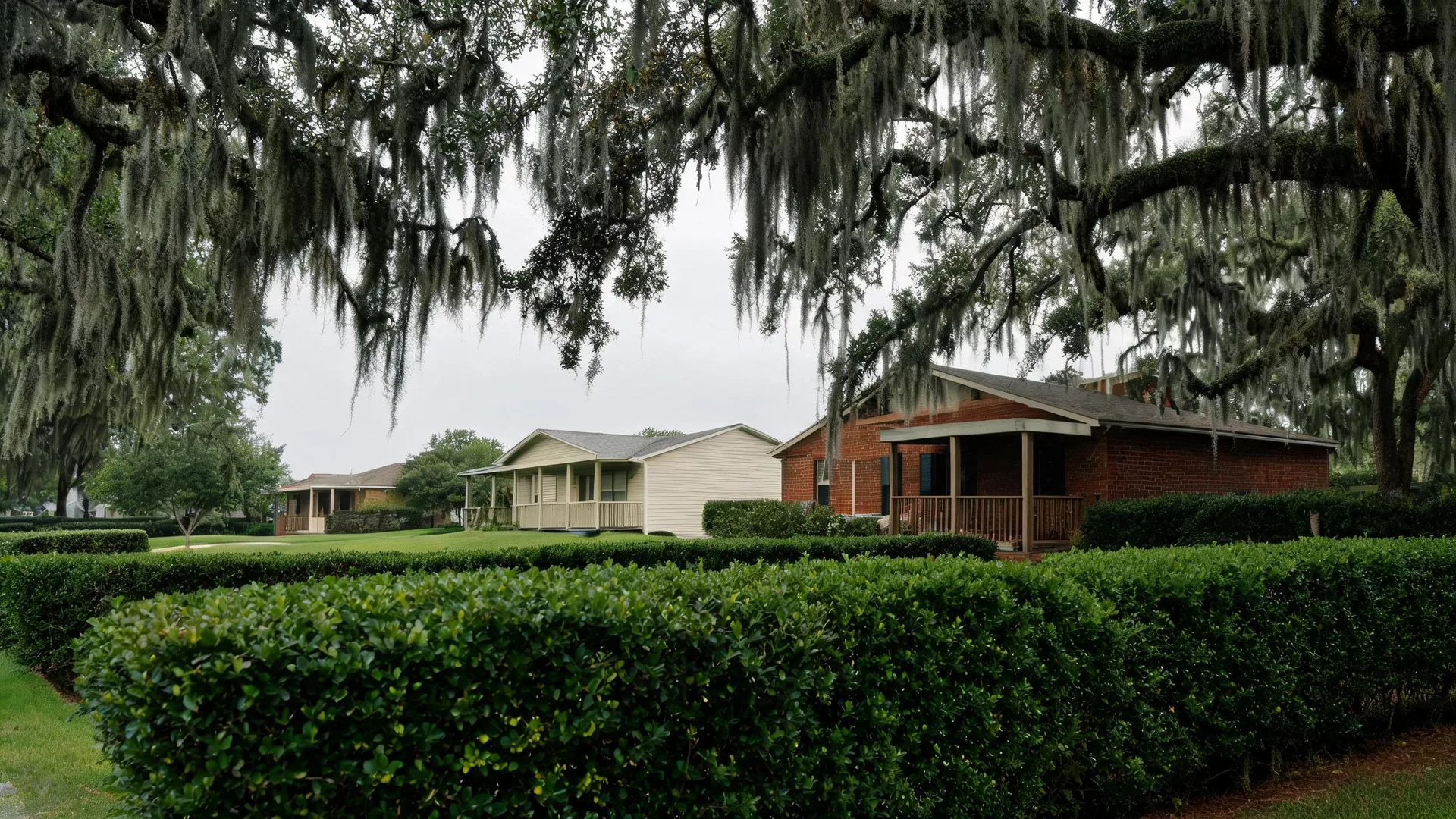
Single-story brick and white-sided houses behind a trimmed hedge and lawn, framed by overhanging oak branches draped with Spanish moss under an overcast sky.

AC Repair in Berryville, AR

Tell us about the job

Takes about a minute. No obligation.

RepairCentral ACCarroll County, AR
Step 1 of 2

What ZIP code is the job in?

The tech checks before touching anything

A tech will ask when the problem started and what the system was doing right before it quit. Then comes the look at the thermostat, the condenser outside, the airflow at the vents, and the refrigerant pressures. That order matters because a weak capacitor, a dirty coil, and a low charge can all look like the same warm air at the register.


The diagnosis tells you what kind of job this is

Some problems end at the diagnosis, a stuck contactor or a tripped breaker gets reset and the system runs again. Others point to something bigger, like a compressor losing its charge over and over, which means the real question is whether to keep repairing this unit or plan for its replacement.

4 months
June through September, your air conditioner is on duty
87°F
the average summer afternoon it cools against
33 hail events
in ten years, and hail bends the fins on outdoor coils
35 wind events
in ten years, and wind drives debris into outdoor units
Isometric illustration of a cutaway single-story house showing attic ductwork, an indoor air handler, interior rooms with furniture, and an outdoor condenser unit connected by lines, on a white background.
Your air conditioner works hardest from June through August.

NOAA nClimDiv, 1991–2020 normals

Berryville summers run four months, June through September, with afternoon highs averaging 87.

A system struggling with a load like that has a real fault somewhere, not a county asking too much of it.

June is when a weak part finally gives out

Cooling runs June through September
Summer afternoons average 87°F
33 hail events from 2015 to 2024

Carroll County sees its share of rough weather, 82 severe events over the last ten years, hail and damaging wind mostly, with a tornado touching down now and then. None of that points to why your AC quit. A hailstone can dent a condenser's fins or a wind-blown branch can nick a line, so it's worth a look if you've had a storm come through recently. But most units stop cooling for the same reasons they would anywhere else, a failed capacitor, a dirty coil, a refrigerant leak. The power outages that come with bad weather here can also trip a system off and leave it needing a simple reset. Worth ruling out before assuming anything worse.

Half the homes in Carroll County were built in 1989 or later

If your AC came with the house, there's a decent chance it's still within its working life. That's a reason to get the real problem found and fixed, not to assume the whole unit is done.

Find a contractor
A man in a dark long-sleeved shirt and brown work pants, seen from behind, carries a worn canvas duffel bag up porch steps toward a green front door of a house with horizontal siding and a potted shrub.
A gray residential air conditioner condenser unit mounted on a concrete pad in an open grass field.

A small fault doesn't stay small

A system that's low on refrigerant doesn't just cool less, it runs longer trying to make up for it. The compressor stays under a load it wasn't built to carry for that long, and the heat it can't shed sits in the windings. Keep running it that way and a slow leak can end in a failed compressor, a different repair than the leak would have been on its own. Same story with a dirty condenser coil. Airflow across it drops, head pressure climbs, and the compressor works harder every cycle to push the heat out. A capacitor that's weak but still working will carry the system for a while, then one hot afternoon it won't, usually right when the system is working hardest. None of these get better by waiting. The unit doesn't fix a weak part by running through it. It just asks more of the parts around it until something else gives out too.

What you'll actually notice first

Warm air from the vents when the thermostat is set low, or the system running nonstop without catching up. Sometimes it's a smell, musty from a dirty coil or sharp like burnt wiring. Sometimes it's sound, a hard click and nothing starting, or a rattle that wasn't there before. A unit that shuts off after a couple minutes and starts right back up is telling you something specific too.

Why these are worth acting on now

A rattle can mean a loose part about to break something else nearby. A system that shuts off and restarts every couple minutes puts a hard strain on the compressor each time it kicks back on. Ice on the lines points to an airflow or refrigerant problem, and running the system that way can turn a fixable repair into a failed compressor. Each sign points a tech toward a different place to look first.

An outdoor central air conditioning unit mounted on a concrete pad beside a blue-sided house at sunset.

A new air conditioner would cut about $40 a year off cooling for a typical Carroll County home.

  • A new one at the federal minimum, 14.3 SEER2$230 a year
  • An older air conditioner$270 a year

Estimates for a typical Carroll County home, compared with an older unit built to the previous federal minimum, from EIA household energy data, Arkansas fuel prices and NOAA climate normals. Your home will differ.

Repair makes sense when a part like a capacitor or contactor has failed.

Replacement makes sense when the compressor has failed or the system uses R-22 refrigerant, which is no longer made.

A tech can tell you what's wrong. Only you can decide what it's worth fixing. Age matters less than what's already failed and what else is close behind it. A unit on its original compressor and original coils, still running the refrigerant it shipped with, is a different case than one that's already had a coil replaced or a compressor swapped before. One repair rarely decides it. What decides it is whether the repairs keep coming, each one a different part, closer together than the last. A cracked heat exchanger or a compressor that keeps losing its charge points toward replacement, because the next failure is already lining up behind the one you just fixed. A bad capacitor or a stuck contactor doesn't tell you that, that's just a part wearing out on its own schedule, same as a belt or a bulb. The honest version of this conversation happens after the diagnosis, not before it, because until someone's found the actual fault you're guessing at a decision that isn't yours to make yet.